MVP Development Guide: How to Launch Your Product in 90 Days
Most products are never launched. Not because they weren't built, but because they were built wrong. Teams spend months or years perfecting features that no one expected, squander budgets chasing imaginary perfection, then launch so late that market conditions have changed or competitors have arrived. The graveyard of brilliant ideas killed by over-engineering is vast.
The Minimum Viable Product (MVP) approach exists as a direct response to this pattern. It's a philosophy that redefines the entire product development process-from building what you imagine users will want to building the bare minimum needed to learn what users really want.
But "MVP" has become one of the most misunderstood terms in the startup world. Some interpret this as cheap and half-baked. Others use it as an excuse to skip important tasks. Neither explanation serves you well.
A true MVP is a strategically designed product that has the features needed to serve real users and generate real learning-no more, no less. This is not a broken product. This one is focused.
This guide will walk you through how to build and launch a real MVP in 90 days. Not a prototype. Not a demo. A real product that real users can use and that generates real insights to guide everything that comes after.
What an MVP Actually Is (And What It Isn't)
The term "minimum viable product" was popularized by Eric Ries in his book "The Lean Startup", but its meaning has varied considerably in popular usage. Before we dive into the how, let's consider the what.
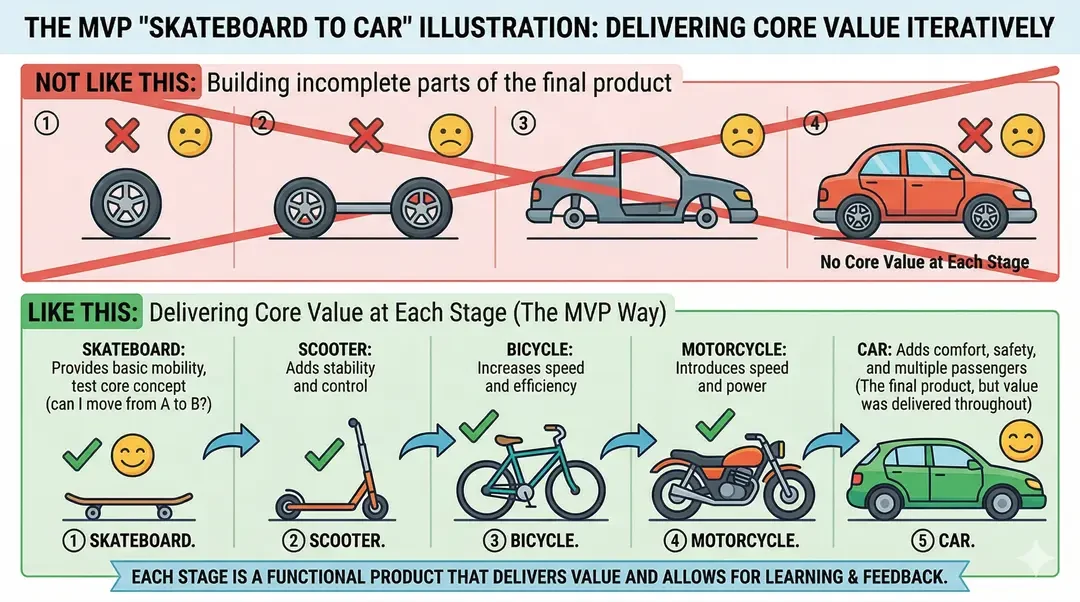
The MVP is the simplest version of your product that provides core value to a specific group of users while allowing you to know if your basic assumptions are correct. Every word in that definition matters.
The simplest version means ruthlessly removing everything that is not essential. It's not the simplest version that your developers want to build or investors want to see-the simplest version that actually serves users. This requires discipline because the impulse to add features is constant and tempting.
Providing core value means the MVP should actually work. It must solve the problem it promises to solve. An MVP that doesn't work isn't minimal-it's broken. Users do not give a second chance to products that waste their time. Your MVP should actually deliver something of value, even if it's somewhat narrower than your ultimate vision.
Having a specific group of users means your MVP is not for everyone. This is for a defined segment whose needs you understand well and can serve. Attempting to serve all potential users in an MVP leads to bloated feature sets and unfocused experiences. Choose your first audience carefully.
Generating learning means that the purpose of an MVP goes beyond generating revenue or users - it's generating knowledge. Are your assumptions about user behavior correct? Does the proposed solution actually solve the problem? Will users pay for it? An MVP that doesn't teach you anything hasn't served its purpose.
What MVP is not:
This is not a crude prototype with placeholder content and broken interactions. This is not a wireframe presented to investors. It's not a full product with every planned feature. It's not an excuse to ship poor quality. And it's absolutely not a one-time effort-MVPs are starting points, not endpoints.
Why 90 Days is the Right Target
Ninety days may seem aggressive or arbitrary. It is none of them. This timeframe is carefully chosen based on how product development actually works and what the MVP needs to achieve.
Long deadlines create dangerous tempo problems. When teams spend six months or a year looking forward to a user's feedback, several things happen. Perceptions become beliefs. The sunk cost bug makes it psychologically difficult to pivot. Market conditions change. Competitors appear. Teams lose motivation as they chase distant horizons. By the time the product is launched, the team has invested so much that they cannot objectively assess whether their basic assumptions were correct.
Short time frames-four weeks, six weeks-rarely produce a truly functional product. They create demos or prototypes that generate a different kind of response from actual users than actual products.
Ninety days creates a productive rush. It's a long way to build something real with proper engineering - not a hackathon project, but production-quality software that real users can trust. It is short enough to maintain focus and prevent feature creep because there is not time for everything.
Three months also fits well with how people think about commitment and progress. Investors, stakeholders and team members can maintain clear focus for up to 90 days. Moreover, attention is lost and the scope narrows.
Once you set your 90-day goal, it should not be negotiable. Flexibility in scope is healthy - if something is more complex than expected, remove a feature rather than extend the timeline. Timeline expansion is the gateway to the kind of extended development cycles that kill products before they even launch.
Phase 1: Discovery and Planning (Days 1-15)
The first two weeks determine whether your next 75 days produce something valuable or something nobody wants. Rushing through planning to start building is one of the most common and costly mistakes in product development.
Validating Your Core Assumption
Every product is built on a core assumption: users have this problem, and your solution will solve it. Before you write any code or design a screen, you need evidence-not conviction, evidence-that this assumption is based on something.
Talk to at least 15-20 potential users in this phase. Not to pitch your product, but to understand their experience with the problem you want to solve. Ask about their current solutions. Understand their disappointment. Listen for patterns that validate or challenge your assumptions.
You are looking for specific signals. Are potential users describing the problem in the same words you are using, or are they presenting it differently? Do they consider it important enough to actively seek a solution, or is it a minor annoyance they have accepted? Have they tried other solutions and found them inadequate, or have they solved the problem well with existing tools?
This user research takes time and seems less productive than building content, which is why teams abandon it. The teams that leave it build products that no one wants and wonder why adoption is bad.
Define your core value proposition
After user research, you should be able to articulate in one sentence what your product does for users. Not a marketing buzzword - a functional description of value exchange. "We help [specific user] achieve [specific result] by [specific mechanism]."
If you cannot complete this sentence clearly, you are not ready to build. Ambiguity at this stage becomes an expensive feature later.
Your core value proposition determines everything about your MVP. Every feature decision becomes a question: Does it directly enable the core value proposition? If so, it might be in MVP. If not, it is not so.
Creating Your Feature List and Ruthlessly Prioritizing
Write down every feature you eventually want to have in your product. Be generous - this is a brainstorm, not a plan. Most teams can generate 50-100 potential features in a product.
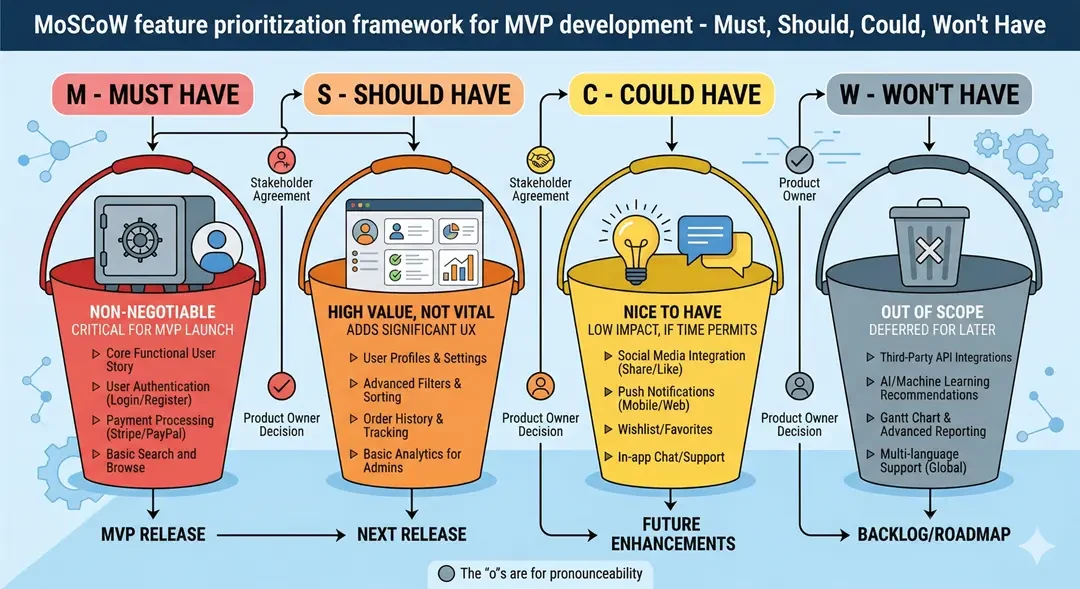
Then implement the MoSCoW methodology with real discipline.
Essential features are those without which your product cannot deliver its core values. These are absolutely shipped in MVP. Most products have five to ten actual "must haves". If you identify with twenty, you are not reckless enough.
There should be features that significantly enhance the core experience, but are not strictly necessary for basic value delivery. These MVPs are candidates for version 1.1 two to four weeks after launch. Users should be able to use and benefit from your product without them.
Could have features are nice additions that will please users but don't affect core functionality. These remain on the product roadmap for future iterations.
Don't want features are explicitly excluded from this development cycle. Writing these down prevents scope creep - when someone suggests adding a feature, check to see if it's on the "don't want" list before seriously discussing it.
The discipline required here is extraordinary. Founders and product managers constantly overestimate what should be in an MVP. Your conscience will say that the ten qualities are "must-haves". Push yourself to identify if you can serve five users.
Choosing Your Technology Stack
Technology decisions made in the discovery phase have long-term consequences. Wrong choices create technical debt that slows down development for months or years.
For most MVPs, the right framework prioritizes development speed and team expertise over theoretical performance or scalability. The best technology for an MVP is technology that your team knows deeply. An expert-level team working in a familiar framework will theoretically outperform a learning team working in a familiar framework.
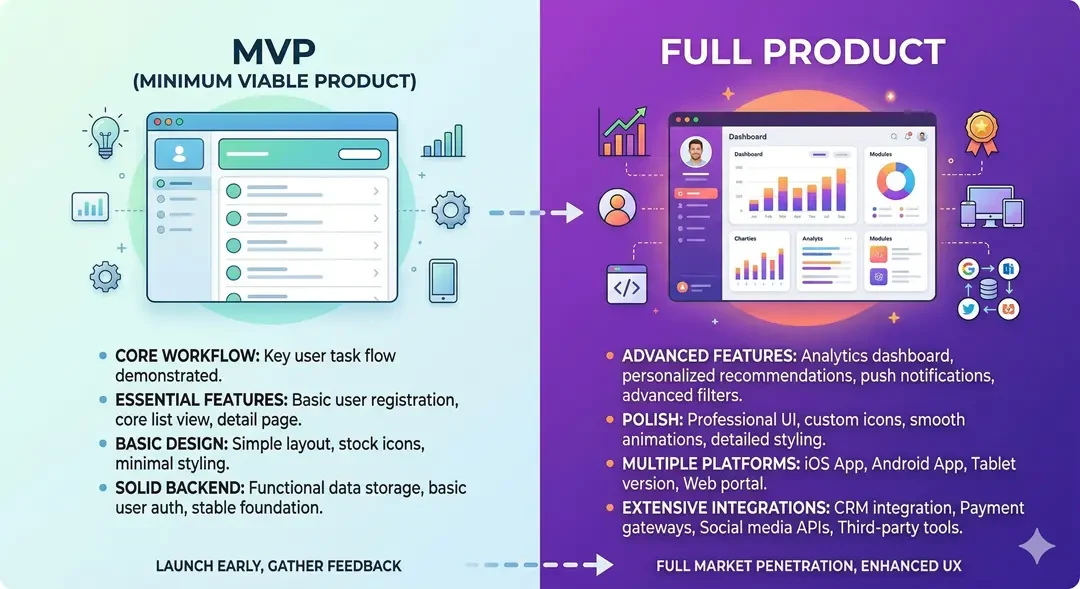
Carefully consider the needs of your platform. If your first users are primarily on mobile, mobile development makes sense. If they are professional users who primarily work on the desktop, web application development may work better. Resist the urge to build everything at once-a web app, iOS app, and Android app are three MVPs, not one.
We've covered technology decisions extensively in our previous guides. Understanding web development frameworks helps in web based MVP. For mobile MVPs, the choice between native vs hybrid vs cross-platform approaches will shape the entire development process. And the Flutter vs React Native comparison helps narrow down mobile framework decisions.
Most MVPs are better served by proven, boring technologies than cutting edge alternatives. Choose a technology stack with plenty of documentation, extensive community resources, and easy-to-find developers. Technical creativity is in your product - not in your infrastructure.
Phase 2: Design and Architecture (Days 16-30)
With validated assumptions, clear value proposition, prioritized features, and chosen technology, the second two weeks focus on design and technical architecture before significant development begins.
User Experience Design: More Important Than You Think
Many teams treat the MVP design as an afterthought - something that can be improved later. This is a mistake with real consequences.
Poor user experience in an MVP produces noise, not signal. If users don't understand how to complete key workflows, you won't learn if your solution works-you'll learn that your design doesn't work. There is another and less useful lesson.
MVP design does not mean beautiful or detailed. Its meaning is clear and functional. Users should understand what your product does as soon as they open it. Core workflows should be intuitive enough that users can complete them without help or documentation. The product must convey value quickly because users have limited patience to learn new products.
Wireframes should be produced in the design phase-skeleton layouts of key screens that establish structure and flow-followed by high-fidelity mockups of the key screens. These don't need to be pixel perfect at this stage, but they should be clear enough that developers can implement them without having to guess your intentions.
Our detailed guide on web development vs web design explains why this design investment is important and how design and development should work effectively together.
Technical architecture: Build for what you need, not for what you imagine
Technical architecture decisions for an MVP should be conservative. Building a scalable architecture for a product that hasn't found its users is premature optimization - you can build for problems you'll never have and create complexity that slows feature development.
Build for maybe ten times, not ten thousand times, your expected first users. If you expect 100 initial users, architect for 1000. If you suddenly need to serve 100,000 people, you will have problems - but it is a wonderful problem, and you'll have resources to solve it.
Define your data model carefully. The structure of your database-what entities exist, how they relate to each other, what attributes each has-is harder to change than anything else once users have generated the actual data. Spend time getting the data model right before coding.
Quickly identify your third-party integrations. Payment processing, email delivery, authentication, storage, analytics-most MVPs rely on third-party services for these capabilities rather than building custom solutions. Identify which services you want to use, understand their pricing models, and account for their limitations in your architecture.
Set up development, staging and production environments right from the start. The discipline of maintaining separate environments-where development happens, where testing happens, where users live-prevents the nightmares that come from deploying tested or unused code into production.
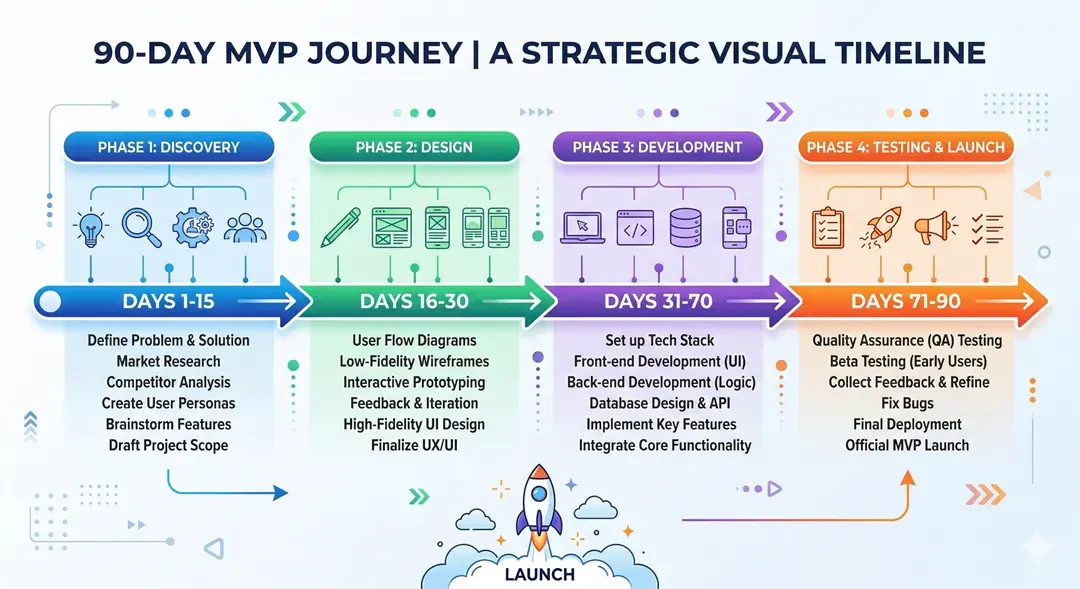
Phase 3: Development (Days 31-70)
The longest phase-forty days of actual building-is where plans meet reality. The decisions made in phases one and two determine whether this phase proceeds smoothly or descends into chaos.
Setting Up for Development Success
Before writing any functional code, spend the first two or three days of the development phase setting up the infrastructure. Configure your repository with a proper branching strategy. Set up continuous integration so that the code can be tested automatically when it is pushed. Configure deployment pipelines for staging and production environments. Establish code review processes, even for small teams.
This infrastructure investment seems slow at first, but significantly accelerates growth. Automated testing catches regressions before they reach users. The deployment pipeline reduces the time and risk of releasing updates. Code review maintains quality and spreads knowledge across the team.
Establish a sprint structure from day one. Two-week sprints work well for MVPs-long enough to complete meaningful features, short enough to maintain rhythm and catch issues early. Each sprint ends with working software, a brief retrospective and a planning session for the next sprint.
The sprint structure creates natural accountability. Stakeholders see progress every two weeks instead of waiting for a big reveal at launch. As the deadline approaches, the problems become increasingly apparent rather than hidden. And the regular rhythm of completion after planning maintains the team's momentum throughout the development phase.
Building in Priority Order
Resist the temptation to build the most exciting or technically interesting features first. Build in strict prioritized order based on feature prioritization done in step one.
Start with the foundation on which everything else rests. For most products, this means user authentication, core data models, and basic navigation. These are not glamorous, but nothing works without them.
Then create your most important user workflow - the most important thing users come to your product to achieve. Before adding secondary features, make sure this primary workflow is complete, functional and clearly reflects your core value proposition.
Once the primary workflow works from start to finish, add secondary functions in order of priority. At each stage you should have a functional product. If you run out of time on day 55, you have something to launch - not all planned, but a real product with real value.
This approach means that the end of your development phase involves adding polish and secondary features to an already functional product. The alternative - trying to build everything and integrate at the end - often produces products that are not truly functional at launch.
Managing Scope During Development
Scope creep is the silent killer of MVPs. New ideas continuously emerge during development. Users you talk to suggest features. Developers look for capabilities as they build. Stakeholders share enthusiastic contributions. Each request sounds reasonable in isolation. Collectively, they turn a focused MVP into an overbuilt delayed product.
Establish a clear process for handling scope extensions. Each suggestion goes into the product backlog – a running list of future features and improvements. Nothing enters today's development momentum without clear agreement that it is more important than something already planned.
When a scope addition seems very important, remove something of similar size. Never add without removing. This maintains the timeline without discarding valuable ideas.
The product backlog becomes a gift: a prioritized list of features for post-MVP development, informed by developer insights and user conversations. At launch, your backlog may contain more promising ideas than the original feature list. This is healthy - it means you are learning.
Quality in an MVP
"MVP" sometimes turns out to be a low-quality license. This should not happen. The difference is not between quality and no quality - it is between complete and incomplete features.
Every feature in your MVP should work correctly. The forms must be correctly validated. Error situations should be handled in an elegant way. Load conditions must be displayed. The product should recover from common errors without crashing. Security must be implemented correctly from day one - adding security later is much more difficult and expensive than building it.
What you sacrifice in an MVP isn't quality - it's quantity. You have fewer functions, fewer case managers, fewer customization options, fewer platforms. But what exists works well.
Understanding front end vs. backend development helps clarify where quality investments matter most. Backend security, data integrity and performance cannot be compromised even in an MVP. Frontend polishing and animation delimiters may be improved after launch.
Phase 4: Testing and Launch (Days 71-90)
The final twenty days separate MVPs that generate learning from MVPs that generate confusion. Testing and launch execution determine whether real users can actually use what you've built.
User Testing: Finding Problems Before Real Users Do
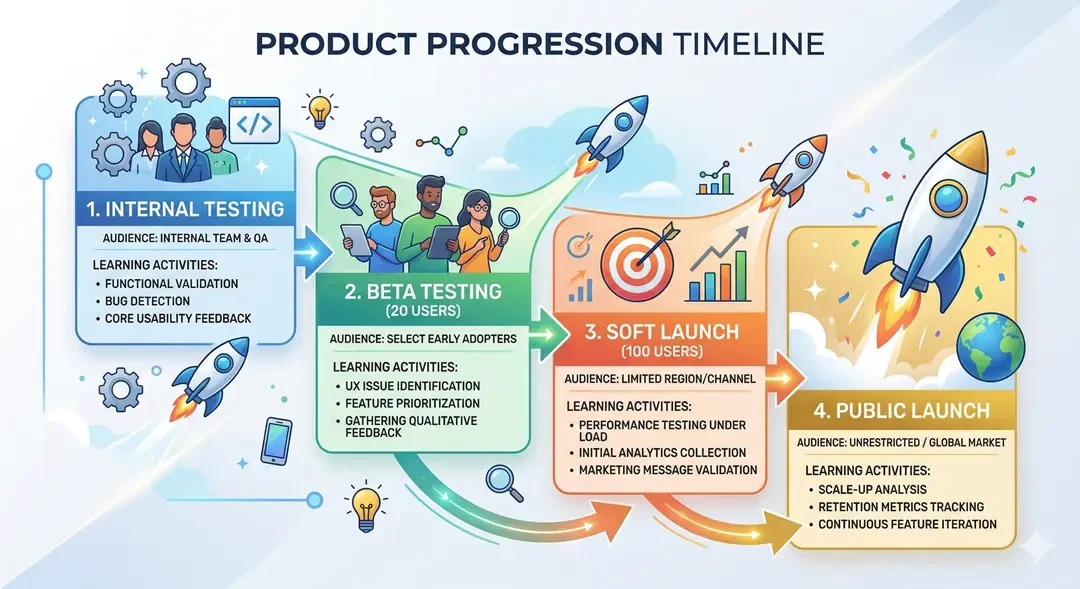
Beta testing with real users-people who fit your target profile but aren't on your core team-is non-negotiable. Internal testing is valuable but insufficient. Your team knows how the product is supposed to work, blinding them to confusing flows and unclear interfaces.
Recruit ten to twenty beta testers who represent your target audience. Give them specific tasks to complete without guidance. See how they interact with the product. Where do they hesitate? What are they doing wrong? Where do they fail to complete tasks?
The aim is not to garner praise - it is to identify problems. A beta tester who struggles through onboarding is more valuable than one who succeeds. His struggle reveals issues that will affect every user who comes after him.
Be relentless in fixing critical usability issues found during beta testing, even if it means delaying launch by a week. Launching with known serious problems creates frustration, not learning. Users who have a bad first experience rarely come back for a second chance.
Small issues - small design improvements, nice feature requests, edge cases - go on the product backlog. They are real and valuable, but they should not hinder the launch.
Performance and Security Testing
Before launch, stress test your application under load conditions. What happens when 100 users log in at the same time? When 1000 requests come to your API in a minute? When a user uploads a large file?
You don't need to simulate millions of users - you just need to simulate a little more than you expect at launch with a certain growth height. Discovering performance issues in testing costs developers time. Finding them after launch costs users and reputation.
Security testing deserves obvious attention. Review authentication implementation. Verify that users only have access to their own data. Test input validation to prevent injection attacks. Ensure that sensitive data is encrypted in storage and transmission. Review third-party dependencies for known vulnerabilities.
Many companies learn a lesson about the importance of the backend the painful way after security incidents or performance failures. Building security from scratch, even in an MVP, is non-negotiable.
Setting Up Analytics and Monitoring
Before launch, implement analytics that will answer your key learning questions. What are you trying to find? What user behavior confirms or challenges your core assumptions?
Implement event tracking for critical tasks. User registration, completion of key workflows, return visits, drop-off points - these events generate data that guides your next iteration.
Set up error monitoring so you know when things go wrong in production. Tools like Sentry catch errors in real time, alert your team and provide enough context to troubleshoot quickly. Finding bugs through user complaints is slower and more damaging than finding them through automated monitoring.
Implement uptime monitoring so you know immediately if your product is down. Every minute of unexpected downtime during early adoption costs user trust that is difficult to rebuild.
Launch Strategy: Soft Launch First
The time period of 90 days does not end in a public launch, but in a soft launch - controlled access to a defined group of users. This is not a failure of ambition; This is a logical continuation of the MVP philosophy.
A soft launch gives you real user behavior data while limiting the blast radius if there are problems. Start with the 50-100 users you have generated during the research phase. These are people who understand that they are using an early product and are motivated to respond.
Monitor obsessively during soft launch. See user behavior through analyses. Read each part of the answer. Be available to respond quickly to questions and problems. This period is learning intensive and support intensive.
After two to four weeks of soft launch, you will have data. You know which functions users actually use. You know where they get confused. You know the questions they ask over and over again. You know whether or not your core value proposition is resonating.
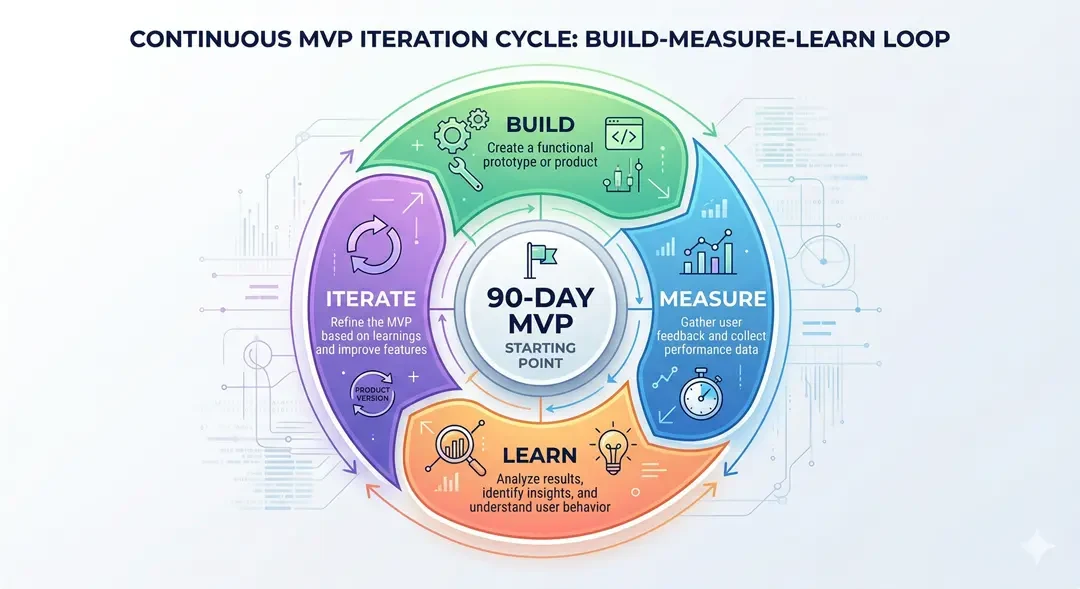
With this data, you make an important decision: continue with a wider launch, make targeted improvements before a wider launch, or move forward based on what you've learned. This decision-informed by real data rather than assumptions-makes MVP development possible.
MVP Development Costs: Setting Realistic Expectations
Building an MVP in 90 days requires investment. Understanding cost limits helps you plan realistically and evaluate proposals from development partners.
For a web-based MVP built by professional development teams in India, expect to invest between $20,000 and $60,000 (₹16L to ₹50L), depending on complexity. A simple MVP with basic user authentication, core workflows and a simple data model sits at the bottom. An MVP with complex business logic, multiple user roles and critical integrations sits at a higher level.
Mobile MVPs cost a bit more due to platform considerations. A mobile MVP on one platform (iOS or Android only) typically costs $15,000 to $40,000 (₹12.5L to ₹33L). Cross-platform mobile MVPs serving both iOS and Android range from $25,000 to $60,000 (₹21 lakh to ₹50 lakh). We have covered mobile development costs extensively in our guide on mobile app development costs in India.
These costs depend on professional development teams, not the cheapest resources available. The MVP stage is absolutely the wrong time to skimp on development quality. Fixing a poor technical foundation built during MVP development becomes costly when trying to scale. It is much easier and cheaper to extend and improve a well-built MVP.
Budgets an additional 20-25% beyond development costs for design, testing, infrastructure setup and readiness. These costs are real and are often excluded from the initial offer.
Understanding the overall cost of software development helps you accurately evaluate proposals. Our comprehensive software development cost guide provides detailed explanations to help you compare quotes sensibly.
What Affects MVP Cost
Functional complexity matters most. An MVP with five simple features costs less than one with five complex features. The complexity includes not only the user-visible functionality, but also the backend logic, integrations, and edges required.
Third-party integration increases costs. Each integration-payment processing, email services, mapping, authentication providers-requires development time for implementation, testing, and error handling. Budget $1,500 to $5,000 (₹1.25 lakh to ₹4 lakh) per critical integration.
The experience of the team significantly affects the cost. Junior teams charge less, but often take longer and generate more technical debt. Senior teams charge more, but often move faster and build a cleaner foundation. For MVPs with tight deadlines, experienced teams often offer better overall value.
Post-launch support is often forgotten. The period immediately after launch requires rapid bug fixing, user support and iteration. Budget for ongoing development capability after launch, not just the initial build.
After 90 Days: What Comes Next
Launching your MVP is the beginning of a product journey, not the end of a development project. What happens in the weeks and months after launch determines whether your MVP investment will be profitable or not.
Measuring What Matters
Resist the temptation to measure vanity metrics - total signups, page views, social media followers. These numbers look good, but don't tell you if your product actually delivers value.
Measure engagement metrics that show true product value. What percentage of registered users complete your basic workflow? How often do users return? At what point in the user journey do most users leave? How many users actively recommend your product?
These metrics, tracked faithfully against realistic benchmarks, tell you whether you've really created something of value or something that's attracting signups but falling short of its promise.
Iteration Based on Real Learning
Your first post-MVP iteration should be driven solely by data and user feedback, not by your original product roadmap. What users actually do with your product is much more valuable information than what you imagined before launch.
Find patterns. Multiple users struggling with the same workflow suggests a design problem. Multiple users requesting the same missing feature suggest a prioritization lesson. A low return visit rate despite positive initial feedback shows that your product provides one-time value, but not ongoing value.
Each iteration should be smaller and more targeted than the MVP. You don't rebuild - you improve. Two to four week iteration cycles help you move forward quickly while still incorporating real learning.
Scaling Decisions
As your MVP gains traction, you'll face scaling decisions-technical scaling as user volume increases, and product scaling as you expand to new features, platforms, or user segments.
Technical scaling is a good problem to have, but it requires active attention. Understanding why growing businesses break on the backend helps you anticipate and prevent the infrastructure failures that often accompany rapid growth.
Product scaling requires the same disciplined prioritization required for MVP development. When the first traction appears, the temptation to expand rapidly in all directions is simultaneously strong. resist it. Focus expansion efforts on user segments and use cases where your product already shows the strongest fit to the product market.
Common MVP Mistakes to Avoid
Even with the right framework, some mistakes crop up again and again in MVP projects. Awareness helps you avoid them.
Build the features you want instead of the features users need. Founders build products for themselves, then realize they are not their own target users. User research, not conviction, should guide feature decisions.
Confusing "minimal" with "poor". Minimum refers to scope, not quality. Every feature should be properly implemented in your MVP. Poor quality does not provide useful learning - it causes user frustration.
The exploration phase has been skipped in order to start the construction work quickly. Two weeks of research prevents months of making the wrong thing. Teams that skip validation rarely regret the overtime; Teams that skip validation almost always regret it.
When the deadlines are missed, the scope increases. The correct response to falling behind schedule is to remove features, not extend deadlines. Each timeline extension increases the risk of problems that MVPs exist to prevent.
Launch at the same time for everyone. Soft launches allow you to catch problems on a smaller scale. Wide launches with serious errors cause damage to reputation and trust that is difficult to rebuild.
Measuring the wrong thing. Vanity measurements sound good. Engagement metrics reveal the truth. Measure what tells you if you provide real value, not what makes your deck impressive.
Considers the projection as the finish line. The MVP launch starts your learning process. Teams that celebrate their launch and lose focus immediately miss the critical learning period that determines whether their investment was worthwhile.
Choosing the Right Partner for MVP Development
Your MVP development partner shapes the outcome as much as your product decisions. The wrong partner gradually creates the wrong thing. The right partner helps you make decisions, move forward faster and build a quality foundation.
Look for partners with MVP-specific experience. Building an MVP requires a different skill set than building enterprise software. The discipline to resist unnecessary complexity, the ability to deliver a functional product on tight deadlines, and the experience to make quick but solid technical decisions separate MVP-competent partners from typical development shops.
Evaluate their process to handle scope and timeline pressures. How do they react when a feature turns out to be more complex than expected? Do they extend the deadline or reduce the scope? MVP partners understand that the timeline is fixed and the scope is flexible.
In particular, check references from previous MVP customers. Ask if the deadlines were met. Ask if the technical foundation is maintained as the products scale. Ask if the team helped customers make better product decisions, not just implement what was asked.
When choosing the right software development company, check extra for MVP projects. The risk associated with partner selection is greater when you are under time pressure and building something that will serve as the foundation for future growth.
Conclusion: The Right Product, Built Right, Launched Fast
The MVP approach isn't about building smaller-it's about building smarter. By launching first with something focused, you generate real learning before investing heavily in a direction that may need to change.
Ninety days is achievable. Teams all over the world launch meaningful MVPs in this time frame every week. But it requires discipline at every step - disciplined discovery that validates assumptions before building, disciplined prioritization that keeps scope focused, disciplined development that maintains quality while moving faster, and disciplined measurement that turns user behavior into actionable learning.
The alternative-an extended development cycle that pursues hypothetical perfection-has a clear track record. Most products created this way launch late, over budget and in markets that thrive without them.
Build minimally. Make it possible. Start it. Then let real users teach you what to build next.
Ready to Build Your MVP in 90 Days?
At ConsoleOps, we've helped startups and enterprises build focused, high-quality MVPs that launch on time and generate real learning. Our process combines disciplined scope management with excellent engineering to deliver MVPs that actually work and set strong foundations for growth.
Start Your MVP Journey with ConsoleOps →
Let's discuss your idea and build a realistic plan for getting to market in 90 days.
Frequently Asked Questions
What is a Minimum Viable Product (MVP)?
An MVP is the simplest version of your product that provides core value to a specific group of users while generating meaningful learning about your core concepts. This is not a rough prototype or unfinished product - it is a focused, functional product with the features needed to serve real users and validate key assumptions. Every feature should work properly in MVP; "Minimum" is the number of features, not their quality.
How long does it take to build an MVP?
Well-planned MVPs for most business applications can be built in 60 to 90 days with a dedicated development team. A simple MVP with basic features can take 45 to 60 days. Complex MVPs with sophisticated backend requirements or multiple integrations may require 90 to 120 days. The 90-day goal balances urgency-quick enough to maintain focus and avoid scope creep-with enough time to build something truly functional and valuable.
How much does MVP development cost in India?
The cost of online MVP development in India usually ranges from $20,000 to $60,000 (₹16L to ₹50L) depending on the complexity. Single-platform mobile MVPs range from $15,000 to $40,000 (₹12.5 lakh to ₹33 lakh), while cross-platform mobile MVPs range from $25,000 to $60,000 (₹21 lakh to ₹50 lakh). Add 20-25% for design, testing and infrastructure. These numbers overestimate professional development teams - cost cutting with inexperienced teams often creates technical debt that costs more to fix than the initial savings.
What features should be included in an MVP?
Only include features without which your product cannot deliver its core value. Use the MoSCoW method: must have features (absolutely necessary for the core value), must have features (important improvements but deferred), may have features (nice additions for later), and must not have features (explicitly excluded). Most MVPs have five to ten actual "essential" features. If you identify several, you are probably not ruthless enough with your prioritization.
What is the difference between an MVP and a prototype?
A prototype is a demonstrable model used to test concepts and gather initial feedback – often not fully functional and usually not deployed to real users at scale. An MVP is a fully functional, production-quality product with limited features that real users can use to achieve real-world goals. Prototypes test whether your concept makes sense. MVPs test whether your product provides value in real-world use. Both are valuable, but they serve different purposes at different stages.
How do I know when my MVP is ready to launch?
Your MVP is ready to launch when it completes the end-to-end core user workflow without any significant errors, passes testing with real users that fit your target profile, handles basic error conditions beautifully, is secured against common vulnerabilities, has analytics to measure key behaviors, and is deployed to a stable production environment. It doesn't have to be perfect - it just has to work reliably for its original purpose.