Top 10 Web Development Frameworks in 2026: How to Choose the Right One
When you decide to build a website or web application, one of the first technical decisions your development team faces is choosing a framework. This option may seem like a purely technical issue that should be left to developers, but it has a profound impact on your business-affecting development speed, contract availability, long-term maintenance costs, and even your ability to scale.
Think of design as the way buildings are constructed. You can build a home using traditional bricks and mortar, modern prefabricated panels or cutting-edge 3D printing technology. Each approach has different costs, timelines, skill requirements, and outcomes. Likewise, web development frameworks provide different foundations for building digital products, each with different advantages and benefits.
In our previous guides, we explored web development vs web design and frontend vs backend development. Now let's learn about the specific tools developers use to build these systems-the framework that powers the modern web.
What Exactly is a Web Development Framework?
Before we compare specific frameworks, let's understand what a framework actually is and why it is important.
A framework is essentially a pre-built foundation of code, tools and best practices that developers use as a starting point to build applications. Instead of writing every piece of functionality from scratch-authentication systems, database connections, routing, security measures- developers use frameworks that provide these common components out of the box.
Imagine building a car. You can build every single component yourself - engine, gearbox, electronics, chassis. Or you can start with a platform that includes the basic structure and core systems, then customize it to create your unique vehicle. Automakers do the latter, which is why companies can share platforms across multiple car models. Frameworks for software work the same way.
Using a framework offers many attractive benefits. Development is much faster because common functionality does not need to be recreated from scratch. Code quality improves as frameworks incorporate established best practices and patterns. Security is stronger because the framework is maintained by large communities that identify and fix vulnerabilities. And maintenance becomes easier because developers familiar with a framework can quickly understand and modify applications built with it.
However, frames also come with limitations. They impose certain structures and patterns that may not suit all use cases. They add overhead that pure custom code doesn't have. And they create dependencies - if the framework becomes obsolete or changes dramatically, applications built on it face challenges.
The most important thing is to choose the right framework for your specific situation, which we will help you understand.

Frontend Frameworks: Building What Users See
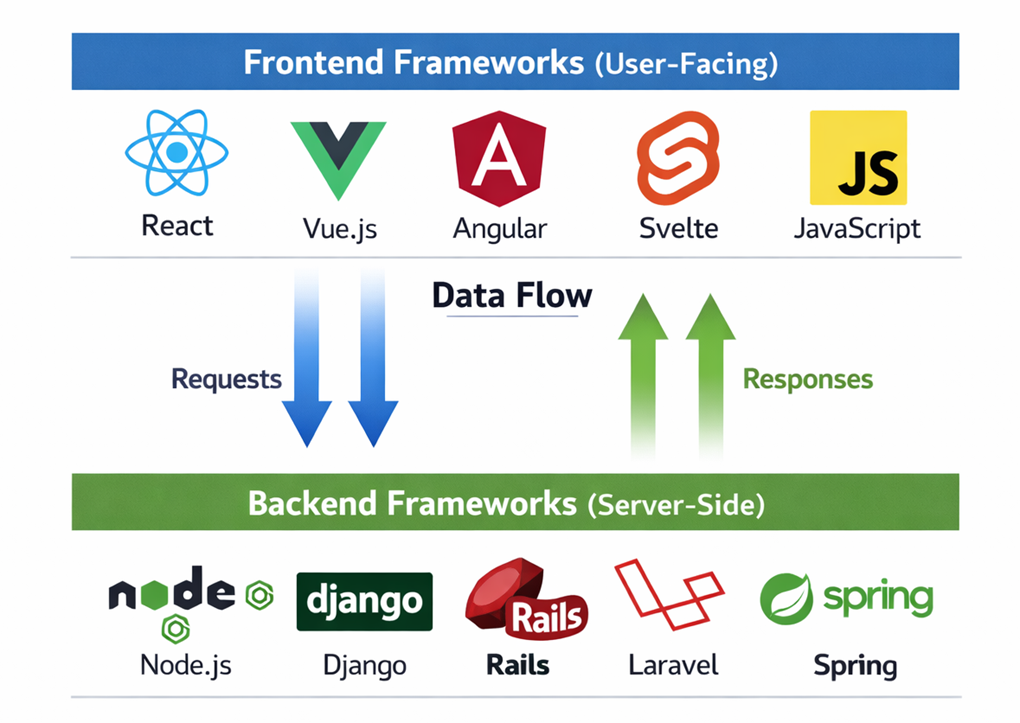
Frontend frameworks focus on the user interface - what visitors see and interact with in the browser. These frameworks have evolved dramatically over the past decade, moving from simple libraries to sophisticated ecosystems capable of building complex, interactive applications.
React: The Industry Standard
Developed and maintained by Meta (formerly Facebook), React has dominated front-end development since its launch in 2013. It powers some of the world's largest applications, including Facebook, Instagram, WhatsApp Web, Netflix and Airbnb.
What makes React special is its component-based architecture. Developers create small, reusable parts of the interface - a button, a form field, a navigation menu - and then combine these components to create an entire application. This approach promotes code reuse, simplifies testing, and makes large applications manageable.
React's virtual DOM technology provides excellent performance. Instead of updating the actual browser interface for every change, React maintains a virtual representation, calculates the minimum necessary updates, and then applies them efficiently. Users experience an intuitive, responsive interface even in complex applications.
The React ecosystem is large and mature. Do you need government management? Redux, MobX or Zustand offer battle-tested solutions. Need server-side rendering for SEO? Next.js provides a complete framework built on React. Do you need component libraries? Material UI, Chakra UI and Ant Design offer pre-built components. Whatever you need, someone probably made it and opened it.
For businesses, the popularity of React means ample availability for developers. Finding React developers is relatively easy compared to more specialized technologies, although top talent is still competitive. The stability of the technology - Meta relies on it for its own products - gives confidence that it will not be abandoned.
The learning curve for React is moderate. Developers need to understand JavaScript well and understand concepts like components, props, state, and hooks. The scale of the ecosystem can be overwhelming - there are many ways to achieve the same goals, requiring decisions that don't require simple frameworks.
Vue.js: The Progressive Alternative
Vue.js emerged as a friendlier alternative to React, created by former Google engineer Evan Yu. It powers applications from companies including Alibaba, Xiaomi, GitLab and Nintendo.
Vue's design philosophy emphasizes accessibility. Developers can start using Vue with only basic HTML, CSS, and JavaScript knowledge, and adopt more advanced features as needed. This steep learning curve makes Vue popular for teams moving from traditional web development or without deep JavaScript expertise.
The framework provides excellent documentation - consistently hailed as the best in the industry. New developers can become productive faster by reducing training time and overhead costs. For companies, this means faster onboarding and less friction in initial development.
Vue provides a single file component format where the HTML, CSS and JavaScript for each component resides in a single file. Developers find it intuitive and organized, although opinions vary depending on personal preferences and project requirements.
The Vue ecosystem, although smaller than React, covers most needs well. Nuxt.js provides server-side rendering capabilities similar to Next.js for React. Vuetify and Quasar offer component libraries. Piniya handles the leadership of the state with grace.
Vue's community, while passionate and growing, is smaller than React's. This means fewer third-party libraries, fewer StackOverflow responses when problems arise, and potentially fewer candidates when hiring. For many projects, however, Vue's ecosystem is more than enough.

Angular: The Enterprise Powerhouse
Angular, developed and maintained by Google, takes a more comprehensive approach than React or Vue. Rather than being a library that you combine with other tools, Angular is a complete framework that includes routing, form management, HTTP clients, and much more right out of the box.
This extensibility makes Angular particularly suitable for large enterprise applications where consistency and standardization are important. When everything comes from a single source with one set of conventions, larger teams can work more collaboratively. Companies such as Google, Microsoft, Samsung and Forbes use Angular for critical applications.
Angular uses TypeScript, a typed superset of JavaScript, as its primary language. TypeScript catches errors during development rather than runtime, improves code documentation, and enables better tooling. For larger teams and long-running applications, these benefits add up over time, reducing errors and making maintenance easier.
The framework's opinions extend to structure and organisation. Angular determines how you organize files, structure components, and handle various issues. This reduces debate about architecture and ensures consistency across the codebase – valuable in enterprise settings, but potentially a hindrance for smaller projects where flexibility is more important.
The learning curve for Angular is steeper than for React or Vue. Developers must learn TypeScript, Angular's specific patterns and conventions, and a more comprehensive API. Training and onboarding takes more time, and finding experienced Angular developers can be more challenging than finding React developers.
For businesses, Angular represents a choice of structure and standardization over flexibility. It shines in larger enterprise applications, especially applications with large teams that take advantage of Angular's defined patterns. Small projects or startups often find the overhead unreasonable.
Svelte: The Compiler Approach
Svelte has a fundamentally different approach to React, Vue and Angular. Instead of sending a framework to the browser and running it there, Svelte compiles your code during the build process, producing highly optimized vanilla JavaScript. The result is smaller bundle sizes and faster runtime performance.
Created by Rich Harris, Svelte has received considerable attention and acceptance since the release of its third edition. Companies including The New York Times, Square and Spotify have used Svelte for a number of projects.
Svelte code is more concise than equivalent React or Vue code. It has less impact, and requires fewer lines for common tasks. Developers often find Svelte a joy to work with, and the compilation method eliminates some of the complexity required for runtime frameworks.
SvelteKit, the official application framework built on Svelte, provides server-side rendering, routing, and other features needed for a complete application. This positions Svelte as a viable option for full-scale web applications, not just interactive widgets.
However, Svelte's ecosystem is much smaller than that of React or Vue. Fewer component libraries, fewer tutorials, fewer StackOverflow answers. Hiring smart developers is more challenging - you'll often be looking for developers who are willing to learn, rather than developers with existing experience.
For companies, Svelte represents a calculated effort. Its performance gains and developer experience benefits are real, but the smaller ecosystem and talent pool create practical challenges. This is increasingly viable for new projects where the team can invest in learning, but migrating existing large applications will be a significant undertaking.
Backend Frameworks: Powering the Engine
While frontend frameworks handle what users see, backend frameworks manage the servers, databases, and business logic that drive applications. Choosing a backend framework involves various considerations - performance under load, security robustness, database integration and operational concerns.
As we discussed in our guide on frontend vs. backend development, the backend is where critical business logic resides. The choice of framework here directly affects security, scalability and long-term maintainability.
Node.js with Express: JavaScript Everywhere
Node.js isn't technically a framework - it's a runtime that allows JavaScript to run outside the browser - but Express.js, built on Node.js, is one of the most popular backend frameworks globally. Together, they enable JavaScript developers to create both frontend and backend, creating teams that share one language across the entire stack.
Express has a minimalist approach, providing basic functionality while leaving most decisions up to the developers. This flexibility allows teams to structure applications according to their preferences, choosing from thousands of packages in the NPM ecosystem for specific needs.
The size of the JavaScript ecosystem is unmatched. Whatever functionality you need - authentication, database connections, file management, image manipulation - there are many packages available. This abundance drives growth, but requires evaluation skills to select quality dependencies.
Node.js excels at handling multiple simultaneous connections efficiently, making it ideal for real-time applications such as chat systems, collaboration tools or live dashboards. The event-driven, non-blocking architecture handles I/O operations without creating a thread for each connection.
Django: Python's Robust Framework
Django, written in Python, describes itself as a "web framework for perfectionists with deadlines." Built to manage news sites under tight editorial deadlines, Django emphasizes rapid development without compromising quality.
Django follows a "batteries included" philosophy, providing built-in functionality for authentication, admin interface, database ORM, caching and more. Developers can quickly create functional applications without integrating multiple third-party packages.
The Django administration interface deserves special mention. Out of the box, Django generates a fully functional administrative interface to manage the application's data. What might have taken weeks to build manually comes free with Django, allowing teams to focus on user-friendly features.
Python's readability makes Django code accessible to developers of various experience levels. The language's popularity in data science and machine learning also makes Django attractive for applications that incorporate AI capabilities- the same language powers both the web application and the models behind it.
Django's security features are strong and enabled by default. Protection against SQL injection, cross-site scripting, cross-site request forgery and clickjacking is standard. For businesses that handle sensitive data, this default-safe approach minimizes risk.
Instagram, Pinterest, Disqus, Mozilla and The Washington Post use Django for their applications. Instagram in particular serves millions of users with Django, demonstrating its ability to scale when properly designed.
Laravel: PHP's Modern Champion
Laravel brought modern development practices to PHP, reviving a language that many had written off as outdated. Created by Taylor Otwell, Laravel combines elegant syntax with powerful features, making PHP development fun again.
Laravel's ecosystem is remarkably complete. Laravel simplifies Forge server deployment. Laravel Vapor enables serverless deployment on AWS. Laravel provides generation of nova admin panel. LiveWire enables responsive interfaces without writing JavaScript. This cohesive ecosystem reduces the burden of integration that plagues more fragmented societies.
The framework's documentation and community resources are exceptional. Laracast, the official video training platform, offers hundreds of hours of instruction. Active forums, conferences and community packs create a supportive environment for developers of all levels.
PHP hosting is abundantly available and affordable. Unlike Node.js or Python, which require specific server configuration, PHP runs on virtually any shared hosting plan. For small businesses or those with limited budgets, this can significantly reduce infrastructure costs.
Companies using Laravel span from startups to enterprises, including Pfizer, BBC, 9GAG, and Crowdcube. Frameworks efficiently handle scales ranging from modest to large, although the largest applications (think billions of requests) typically use languages designed for high performance.
For businesses, Laravel represents excellent value. The pace of development is high, the talent is available, and the ecosystem covers most needs. PHP's reputation issues aside, Laravel efficiently produces maintainable, scalable applications.
Ruby on Rails: The Original Startup Framework
Ruby on Rails, also often called Rails, gave rise to many concepts that are now standard in the framework - conventions about configuration, RESTful architecture and integrated testing. Created by David Heinemeier Hansson when building Basecamp, Rails prioritizes developer happiness and productivity.
Rails established that frameworks should make common tasks moderately easy. Creating a new database table, creating a CRUD interface, setting up authentication - Rails generators generate working code in seconds that would take hours to write manually.
Framework conventions reduce decision fatigue. Instead of arguing about where files should go or how to name things, Rails decides the answer. Teams that follow Rails conventions produce consistent code that other Rails developers can quickly understand.
Shopify, GitHub, Airbnb, Hulu, and Twitch are either built on Rails or use it heavily. Shopify, one of the world's largest e-commerce platforms, is committed to Rails and contributes significantly to its development.
However, the popularity of Rails has fallen from its peak. Ruby as a language is less popular than Python or JavaScript, which makes recruiting developers more challenging. Performance, while adequate for most applications, does not match more modern frameworks. The "magic" that makes Rails productive can confuse developers trying to understand what's really going on.
For enterprises, Rails is still viable, especially for startups that prioritize development speed over raw performance. Framework maturity means stability and proven patterns. However, the shrinking Ruby community needs to be considered, especially for long-term projects.

Spring Boot: Java's Enterprise Standard
Spring Boot, built on the Spring Framework for Java, dominates enterprise backend development. When banks, insurance companies and large companies build critical systems, they often choose Spring Boot.
Java's stability and backward compatibility provide peace of mind for long-term systems. Code written decades ago often runs on modern Java versions with minimal changes. For applications that operate for years or decades, this stability matters significantly.
Spring Boot's automatic configuration reduces the traditional complexity of Java development. What once required extensive XML configuration now works with simple annotations. Developers can quickly create production-ready applications while maintaining access to the full power of Java when needed.
The enterprise ecosystem around Java and Spring is huge. Monitoring tools, profiles, application servers, IDE support - decades of enterprise focus have produced sophisticated tools that other ecosystems are still developing.
Performance and scalability are the strengths of Spring Boot. Java applications handle concurrent users efficiently, and the optimization capabilities of the JVM mean that applications often become faster over time as the runtime learns usage patterns.
However, higher wages are required, and extensive Java code (despite modern improvements) means more lines of code for equivalent functionality. For startups or small projects, this overhead may not justify the benefits.
Companies using Spring Boot include Amazon, Google, Microsoft, eBay, and almost every major financial institution. When reliability and performance matter more than development speed or cost, Spring Boot is a natural choice.
Choosing the Right Framework for Your Business
Understanding individual frameworks helps, but the real challenge is choosing the right framework for your specific situation. This decision involves technical factors, business considerations and practical constraints.
Consider your project type
Fits different projects different frameworks. A content-heavy website benefits from a framework with excellent server-side rendering and SEO support - Next.js (React), Nuxt.js (Vue) or Django work well. A highly interactive application with a complex user interface suitable for React or Vue with robust state management. A simple marketing site may not need a complex framework at all.
E-commerce applications benefit from frameworks with mature ecosystems for payment processing, inventory management and security. Enterprise applications often favor the architecture of Angular or the robustness of Spring Boot. Real-time applications such as chat or collaboration tools work well with the event-driven architecture of Node.js.
Understanding your project type helps narrow down your framing options before evaluating other factors.
Evaluate Developer Availability
The most technically excellent framework won't help if you can't find or afford skilled developers in it. React developers are plentiful; Svelte developers are rare. This availability affects employment timelines, salary requirements and contractor options.
Also consider your geography. Developer availability varies by location. Large technology centers have diverse talent; In smaller markets there may be concentrations within specific technologies based on local business presence or educational institutions.
When choosing a software development company, ask about their framework expertise. A company that has experience with your chosen framework will be more efficient than a learning company when building your application.

Think About Long-Term Maintenance
Applications rarely remain unchanged. Features are added, bugs are fixed, integrations are evolving. The choice of framework affects how expensive and difficult it will be to maintain.
Frameworks with larger communities provide more continuous support – updates, security patches, compatibility improvements. Frameworks supported by large companies (React by Meta, Angular by Google, Spring by VMware) have resources for long-term maintenance that independent projects may lack.
Also consider the path of the structure. Is its popularity increasing or decreasing? Growing structures attract talent and resources. Declining infrastructure leads to a drain on talent, making future maintenance difficult.
Match Budget to Framework Costs
The choice of framework affects the development cost in several ways. Hourly rates for developers vary by technology - Java developers typically cost more than PHP developers. Development speed varies - Rails and Laravel enable faster initial development than more detailed frameworks. Whether you're building features or buying packages, the completeness of the ecosystem is impressive.
Infrastructure costs also vary. Node.js and Go applications typically require fewer server resources than Java or .NET applications. PHP hosting is cheaper than most alternatives. Cloud platform prices vary depending on how efficiently different runtimes use the resources.
Calculate the total cost of ownership, not just the initial development costs. A cheap initial build that is expensive to maintain or scale may end up costing more over the life of the program.
Don't Underestimate Team Expertise
If your team already knows React in depth, choosing Angular for a new project increases learning time and decreases startup speed. Leveraging existing expertise generally outweighs the theoretical benefits of alternative frameworks - unless those alternatives offer attractive benefits for your specific situation.
For new teams or projects where you hire specifically for this work, you have more flexibility. But still, building on strengths rather than introducing unnecessary complexity yields better results.
What We Recommend for Different Scenarios
After building applications across all frameworks for different customers, patterns emerge about what works well in different situations.
For startups building an MVP, React or Vue combined with Node.js or Django offers rapid development, available talent and the flexibility to evolve. Laravel is excellent if the team knows PHP or the budget is limited.
For enterprise applications with larger teams, Angular or React with TypeScript on the front end, combined with Spring Boot or .NET on the backend, provide the structure and tools larger organizations need.
For content-heavy sites that require SEO, Next.js (React) or Nuxt.js (Vue) provide server-side rendering with a modern development experience. Django or Laravel also handle content applications well.
For real-time applications, the Node.js backend handles WebSocket connections efficiently. Pair with React, Vue or Svelte on the front end depending on team preference and interface complexity.
For AI-integrated applications, the Python backend (Django or FastAPI) allows seamless integration with machine learning models. The same language works on APIs and AI components.
Remember that technology is no longer optional for business success. As we explored in our article Why Technology is No Longer Optional in 2026, making informed technology decisions has become critical to competitive survival.

Conclusion: Framework Choice is a Business Decision
Choosing a web development framework is not entirely a technical decision that developers should make in isolation. This affects your budget, employment opportunities, speed of development, maintenance costs and long-term flexibility. Understanding the scenario helps you participate meaningfully in these decisions and ask the right questions.
The "best" framework does not exist universally - only the best framework for your specific situation. The dominance of React doesn't mean that Angular is wrong. The efficiency of Laravel does not mean that Spring Boot is excessive. Each framework exists because it solves real problems for real projects.
What matters is the fit between the company's needs, project requirements, team capacity and framework characteristics. When these are well adapted, development goes smoothly. When misaligned, even excellent developers struggle with inappropriate tools.
Consider this decision carefully, but don't let analysis paralysis get in the way of progress. Modern frameworks are capable of creating excellent applications. A good framework executed well beats the alternative of a perfectly executed poorly executed framework every time.
Ready to Choose the Right Technology for Your Project?
At ConsoleOps, we work with clients to select the optimal technology stack for their specific needs. Our expertise spans React, Vue, Angular, Node.js, Django, Laravel, and more - allowing us to recommend based on your requirements, not our preferences.
Discuss Your Project with ConsoleOps →
Let's explore which technologies will best serve your business goals.
Frequently Asked Questions
Which web framework should I choose for my startup?
For most startups, React or Vue for the frontend, combined with Node.js (Express) or Django for the backend, provides an excellent balance. These technologies enable rapid development, have plenty of developer availability, and scale well as you grow. Laravel is also excellent if the budget is limited or your team knows PHP. The key is to choose frameworks that your team can execute well, rather than theoretically optimal choices that slow down development.
Is React better than Angular?
None of these are objectively better – they solve different problems in different ways. React offers flexibility and a large ecosystem, making it ideal for a variety of projects and teams that want control over their architecture. Offering extensive infrastructure and TypeScript integration, Angular excels in large enterprise applications with large teams that benefit from defined patterns. Your choice should depend on project size, team expertise and organizational priorities.
Do I need different frameworks for frontend and backend?
Yes, typically. Frontend frameworks (React, Vue, Angular) run in browsers and handle user interfaces. Backend frameworks (Node.js/Express, Django, Laravel, Spring Boot) run on servers and handle business logic, databases, and APIs. Some developers use Node.js to write JavaScript on both frontend and backend, creating a unified language environment, but you still use distinct frameworks for each layer.
How does framework choice affect development cost?
Framework choice affects cost through developer rates (Java developers cost more than PHP developers), development speed (Rails and Laravel enable faster initial development), ecosystem completeness (mature ecosystems reduce custom development requirements), and infrastructure requirements (some frameworks require more server resources). Consider not only the initial growth, but also the total cost of ownership including maintenance.
Should I choose a popular framework or an emerging one?
Popular frameworks offer stability, abundant talent and a mature ecosystem – generally a safe choice for business applications. New frameworks can offer technological advantages, but come with recruitment challenges, small ecosystems and uncertainty about long-term feasibility. Unless new technology offers attractive benefits for your specific use situation, established frameworks generally provide better risk-adjusted results.
Can I switch frameworks later if I choose wrong?
Technically yes, but it is expensive and time-consuming often to the point of rebuilding the application. Frame decisions are sticky. Changing front-end frameworks requires rewriting all user interface code. Switching backend frameworks requires rewriting all business logic and database interactions. Although not impossible, the cost makes the initial choice of framework important. However, well-designed applications with clear separation can sometimes replace one layer while preserving others.