Flutter vs React Native in 2026: Which Framework Should You Choose?
You have decided to create a mobile app that works on both iOS and Android. Smart Choice - Reaching users on both platforms maximizes your marketing potential. But now you're faced with a decision that has sparked passionate debate in the tech community: Flutter or React Native?
Both frameworks promise the holy grail of mobile development - code once, deploy on both platforms. Both are backed by tech giants. Both streaming apps are used by millions of people. And both have passionate supporters who will insist their choice is clearly superior.
The truth is, as always, more nuanced. No framework is universally better. The right choice depends on your specific situation - your app's needs, your team's expertise, your timeline, your budget, and your long-term vision.
This guide cuts through the noise to give you clear, practical comparisons. We will honestly examine both frameworks, recognize their strengths and weaknesses, and help you make an informed decision that will meet your business goals.
If you're still considering whether cross-platform development makes sense for your project at all, our guide on mobile app development costs in India provides context for how choosing a platform affects your budget.
Understanding the Cross-Platform Promise
Before we specifically compare Flutter and React Native, let's understand what cross-platform development offers and why these frameworks exist.
Traditional native development requires building separate apps for iOS and Android. You hire Swift or Objective-C developers for iOS, Kotlin or Java developers for Android, essentially building your app twice. Apps perform great on their respective platforms, but development costs double, timelines increase, and maintaining feature parity between versions becomes an ongoing challenge.
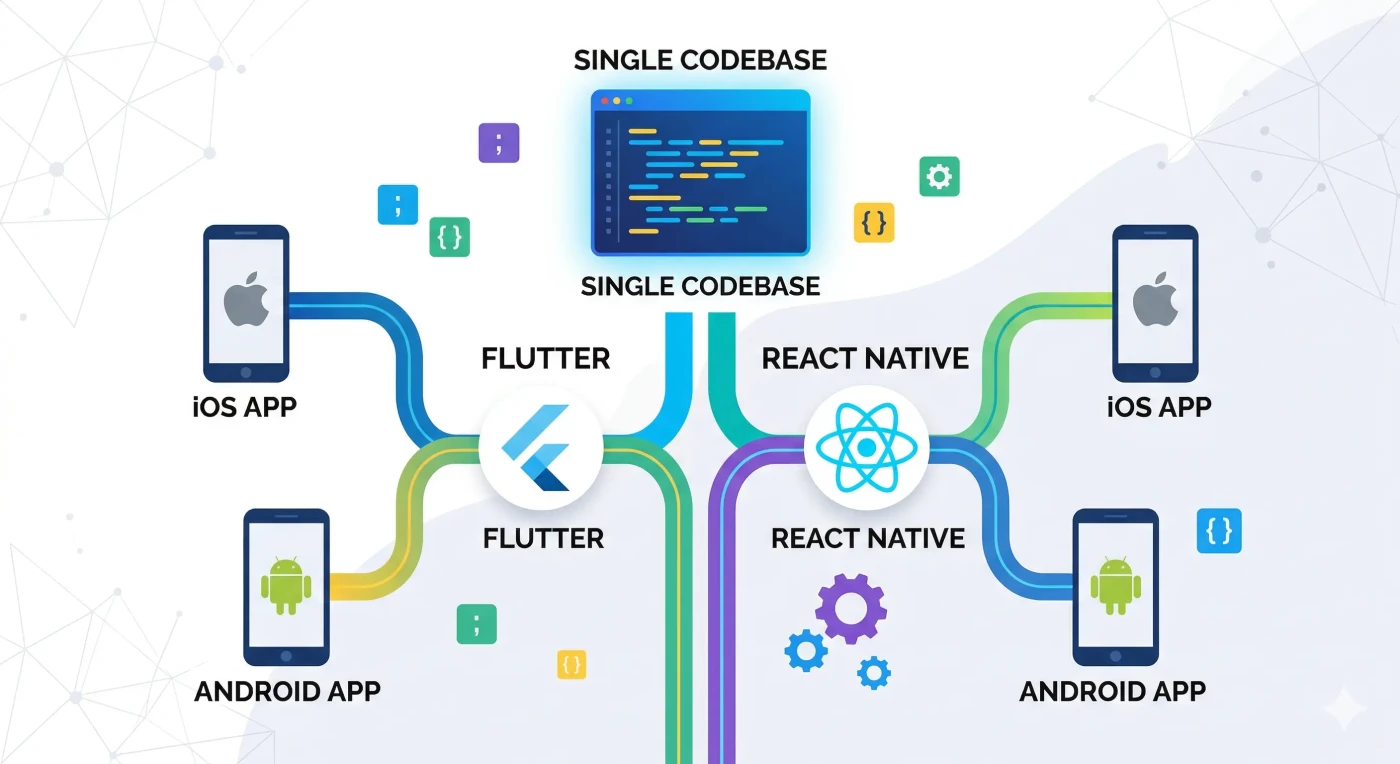
Cross-platform frameworks emerged to solve this problem. Vision: Write your app's logic once in a single language, then deploy to both iOS and Android. Development costs are reduced, deadlines are shortened, and one team maintains one codebase instead of two.
But early cross-platform efforts had serious shortcomings. The performance was after native apps. The user interface felt foreign on one or both platforms. Developers continued to struggle with the framework's limitations. Many companies have tried cross-platform development, had a bad experience and reverted to native development.
Flutter and React Native represent a new generation that largely overcomes these historical limitations. Both create apps that look, feel and perform so well that most users can't tell they weren't created on their own. This leap in quality has made cross-platform development viable for more projects than ever before.
The question is no longer "Should I use cross-platform development?" For many projects, the answer is a clear yes. Now the question is "Which cross-platform framework is best suited for my situation?"
Meet the Contenders
React Native: The JavaScript Pioneer
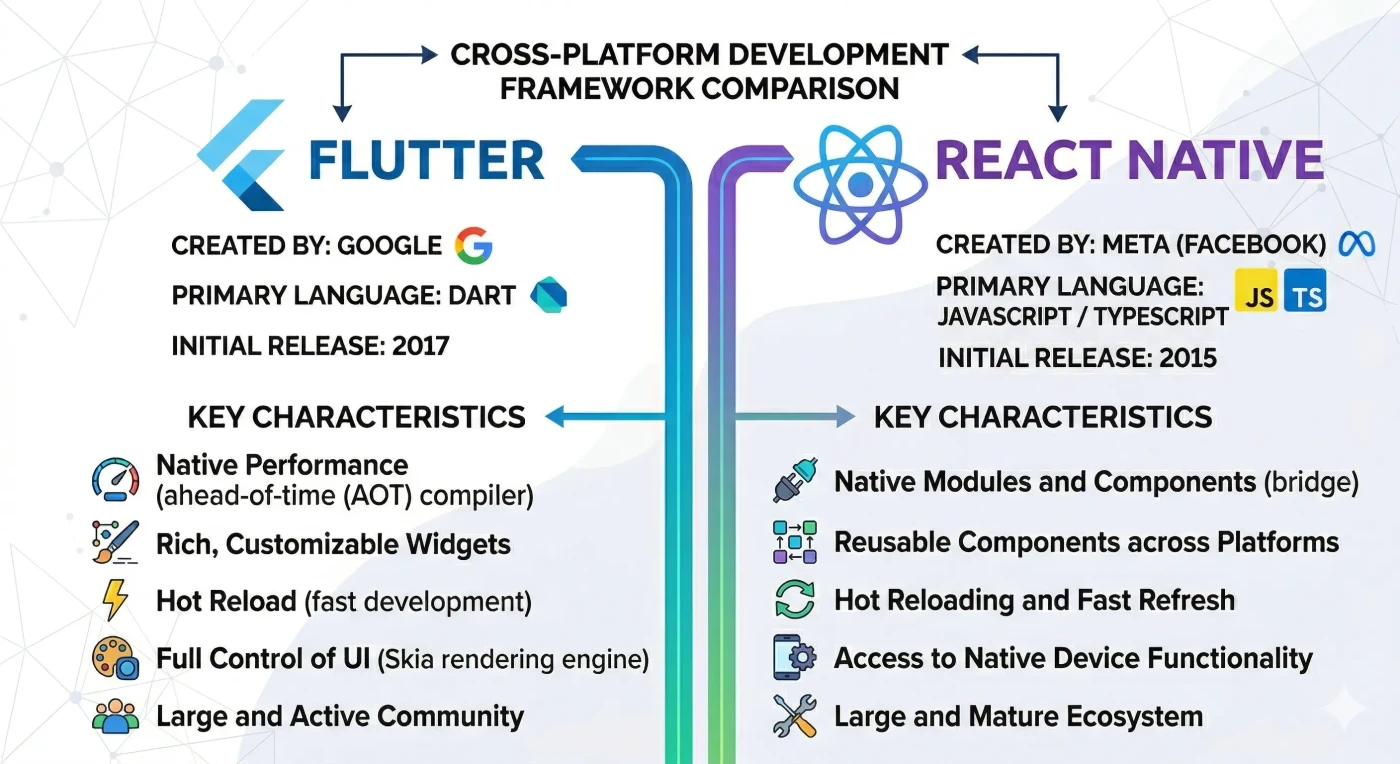
React Native emerged from Facebook (now Meta) in 2015, bringing React's component-based approach to mobile development. If you're familiar with React for web development - and millions of developers are - then React Native seems like a natural extension.
The framework uses JavaScript, the world's most widely used programming language. This immediately opens up React Native development to a huge pool of JavaScript developers worldwide. A web developer with React experience can become productive relatively quickly with React Native, making team building and scaling easier than with more specialized technologies.
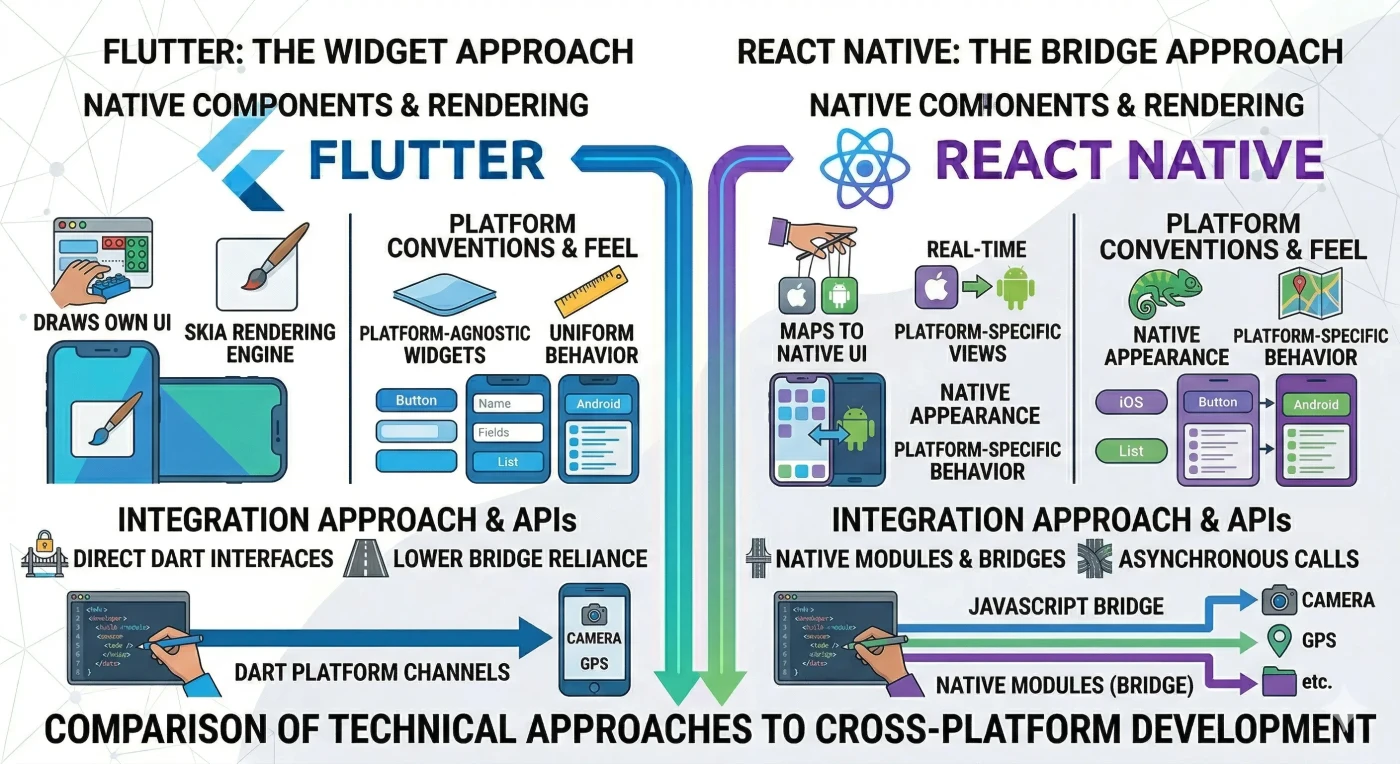
React Native works by rendering native platform components. When you create a button in React Native, it becomes a real iOS button on iPhone and a real Android button on Android phones. This approach ensures that apps feel truly native because they use the real interface components expected by users.
The React Native ecosystem is mature and extensive. There are countless libraries for virtually every common need - navigation, state management, animations, entity functions, and more. Whatever functionality you need, someone has probably solved the problem and shared their solution.
Major apps built with React Native include Facebook, Instagram, Walmart, Bloomberg, Discord, Pinterest, and Shopify. These are not simple apps - these are complex, high-performance applications that serve millions of users. Their success largely demonstrates the capabilities of React Native.
Flutter: Modern Challenger
Flutter came from Google in 2017, taking a fundamentally different approach to cross-platform development. Instead of rendering native components like React Native, Flutter creates its own interface using a high-performance rendering engine called Skia.
This approach means that Flutter controls every pixel on the screen. The positive side of this is that there is full design freedom and complete uniformity across all platforms - your app looks the same, pixel for pixel, on iOS and Android. The downside is that Flutter apps don't automatically follow platform conventions unless developers explicitly enforce them.
Flutter uses Dart, a programming language developed by Google. While Dart is less well-known than JavaScript, it was designed with UI development in mind and offers features that make building interfaces more fun. Developers new to Dart generally find it easy to learn, especially for developers with experience in Java, JavaScript, or C#.
Flutter's architecture includes an extensive widget library that covers most interface needs out of the box. Unlike React Native, where you often string together multiple third-party libraries to achieve your goals, Flutter provides cohesive solutions to common challenges as part of its core framework.
Major apps built with Flutter include Google Pay, BMW, eBay Motors, Alibaba, Philips Hue, and Toyota. Google's own commitment to Flutter - using it for important internal projects - gives confidence in its long-term viability.
Performance: The Technical Reality
Performance debates between Flutter and React Native generate more heat than light. Let's examine what actually matters.
Understanding the Architecture Difference
React Native connects JavaScript code to native platform components through "bridges". Your JavaScript logic communicates with embedded code through this bridge, translating instructions back and forth. This architecture works well for most applications, but can become a bottleneck for apps that perform very performance-intensive operations - complex animations, heavy calculations, or pushing thousands of UI updates per second.
The React Native team addresses this limitation with a new architecture with TurboModule and Fabric, which significantly reduces bridge overhead. By 2026, this new architecture has matured and been widely adopted, reducing the performance gap that previously existed.
Flutter compiles directly to native ARM code without interpretation or bridging. The Dart code you write becomes embedded machine code that runs directly on the device. The Skia rendering engine draws interfaces at up to 120 frames per second on capable devices. This architecture provides more consistent performance, especially for animation-heavy or graphically complex applications.
Real-World Performance
For most business applications, both frameworks provide excellent performance that users will find indistinguishable from native apps. Feed scrolling, form interactions, navigation transitions and standard animations run smoothly on both. Theoretical performance differences rarely manifest as user-perceivable problems.
Where performance differences appear is in the edge cases. Games or apps with complex real-time graphics can support Flutter's direct rendering method. React Native's bridge architecture can add little overhead to apps that require extensive communication with platform-specific native code.
But let's be realistic: if you're building an app where millisecond differences in performance matter, you're probably building something that requires native development. For standard business applications, e-commerce, social features, productivity tools, and similar use cases, both Flutter and React Native work great.
The Honest Assessment
Flutter has a slight performance advantage in benchmarks and theoretical analysis. In practice, this difference probably matters for 5% of mobile app projects – those with extreme performance requirements where native development may be more appropriate anyway.
For most business applications, performance should not be the primary deciding factor. Both frameworks are quite fast. Focus on the factors that will really affect the success of your project.
Developer Experience and Productivity
How fast and enjoyable can developers build with each framework? This has a direct impact on your timelines and costs.
The JavaScript Advantage
React Native's use of JavaScript provides an important practical benefit: developer accessibility. JavaScript is the world's most popular programming language, with an estimated 17 million developers worldwide. React has seen widespread use especially for web development, and has created a large pool of developers who can make changes to React Native.
This availability leads to easier hiring, more competitive pricing and more choice when choosing development partners. When choosing a software development company, you will find much more React Native expertise compared to Flutter expertise.
For teams already building web applications with React, React Native enables code sharing between web and mobile. Business logic, API integration code and state management can often be transferred directly. This synergy can significantly accelerate mobile development for companies with existing React Web applications.
The Dart Experience
Flutter's Dart language, although lesser known, provides an excellent development experience. Dart was designed specifically for creating user interfaces, and this shows its focus. Features like zero security, strong typing, and async/await syntax make your code more reliable and easier to maintain.
Flutter's "Hot Reload" feature transforms the development workflow. Changes to the code are reflected almost immediately in the running app without losing application state. Developers can make changes to the interface, adjust the logic and see results immediately. While React Native also offers hot reloading, Flutter's implementation is generally considered faster and more reliable.
Flutter's extensive widget library reduces dependency on third-party packages. Where React Native developers can integrate up to five different libraries to achieve their navigation, animation, and UI goals, Flutter developers often achieve this by using built-in widgets. This connection reduces compatibility problems and simplifies maintenance.
Learning Curve Comparison
For developers with JavaScript and React experience, React Native has an easier learning process. Existing knowledge is transferred directly, and the conceptual model becomes known. A competent React developer can become productive with React Native in just a few weeks.
Flutter requires learning Dart, which adds initial overhead. However, Dart is easy for developers with experience in scripting languages such as Java, C# or TypeScript. Most developers report that they become comfortable with Dart within two to four weeks of focused learning.
Flutter's widget-based architecture differs from React's component model in ways that require mental adjustments. It takes time to understand widget trees, state management patterns, and Flutter's specific approach. However, many developers ultimately find Flutter's model more intuitive.

User Interface and Design Flexibility
How your app looks and feels directly impacts user engagement. Both frameworks approach UI differently, with important implications.
React Native's Native Component Approach
React Native renders actual native platform components. A button in your React Native app is a real iOS UIButton on iPhone and a real Android button on Android. This ensures that your app automatically respects platform conventions – iOS apps feel like iOS apps; Android apps feel like Android apps.
This native rendering approach means that platform updates automatically make your app better. When Apple introduces new button styles or Android updates its Material Design components, React Native apps receive these improvements without code changes.
However, this approach also means that your app will look different on each platform. The same code produces an iOS-style app on iPhone and an Android-style app. For many apps, this cross-platform appearance is desirable. For brands that want pixel-perfect consistency across all platforms, additional work is required.
Achieving highly custom designs in React Native sometimes requires more effort. Since you're working with built-in components, deviating dramatically from the default look means customizing or changing those components - possible, but sometimes complicated.
Flutter's Pixel-Perfect Control
Flutter draws each pixel using its own rendering engine. It provides complete design freedom - you can create any imaginable interface without being constrained by built-in component limitations. Highly branded, unique visual experiences are Flutter's strength.
Your Flutter app looks the same on iOS and Android by default. Every animation, every shadow, every curve renders exactly the same. For brands that prioritize visual consistency, this is compelling.
However, this control comes with responsibility. Flutter doesn't automatically follow platform conventions - you must implement them intentionally. A Flutter app might use material design on both platforms, which can feel slightly foreign to iOS users expecting iOS-specific patterns. Alternatively, developers can implement platform-specific designs, but this requires additional work.
Flutter's extensive widget library includes Material Design widgets and Cupertino (iOS-style) widgets. Developers can use platform detection to show appropriate widgets on each platform, achieving native-feeling interfaces with some additional effort.
Design System Integration
If your company has an established design system, Flutter is often easier to integrate. Since Flutter controls all rendering, it's easy to enforce precise specifications for colors, typography, spacing, and custom components.
React Native can implement custom design systems, but may require multiple solutions when designs do not match built-in component properties.
For standard applications without very specific design requirements, React Native's automatic cross-platform styling simplifies development. For brands with strong visual identities that require precise implementation, Flutter's control proves valuable.
Ecosystem and third-party support
No framework provides everything out of the box. The ecosystem around each framework determines how easily you can add features beyond the core features.
React Native's Mature Ecosystem
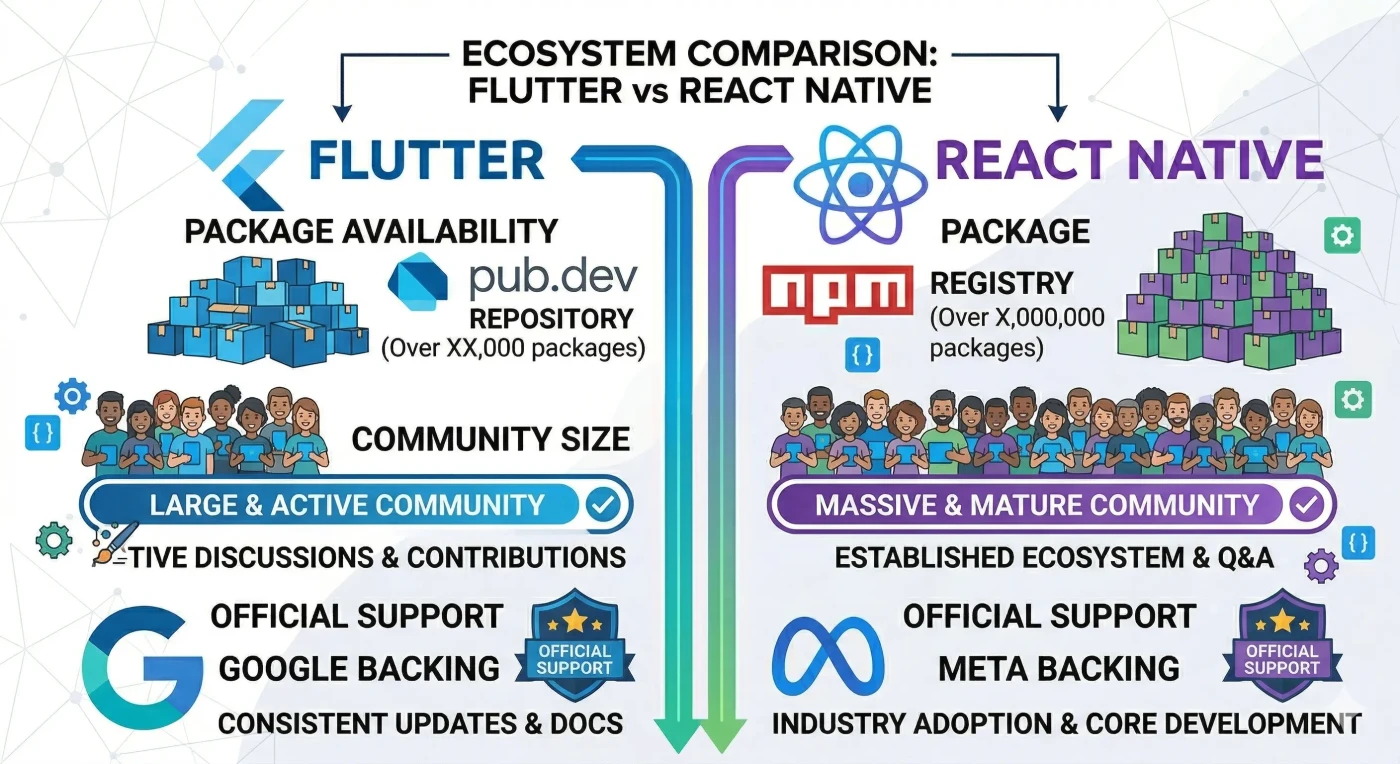
Compared to Flutter, React Native benefits from six years of additional maturity. The npm ecosystem includes thousands of React Native packages that cover almost every need - camera access, maps, payments, analytics, push notifications, and countless special features.
This maturity means that solutions to most problems have been established. StackOverflow includes answers to common React Native questions. Blog posts, tutorials and courses abound. When developers encounter challenges, help is usually available.
However, there are shortcomings in the maturity of the ecosystem. Older packages may be poorly maintained, incompatible with newer React Native versions, or abandoned altogether. The quality varies widely between different packages. Evaluating and selecting appropriate packages requires experience and judgment.
The fragmentation of the JavaScript ecosystem means that multiple packages often solve the same problem in different ways. Developers must choose between competing options for navigation, state management, UI components, and other common needs. These choices affect the architecture and can complicate later changes.
Flutter's Cohesive Ecosystem
Flutter's ecosystem is young but growing fast. Pub.dev, Flutter's package repository, has thousands of packages, but fewer than npm. This gap is closing monthly as Flutter's popularity drives package development.
Google offers official packages for many common needs - Firebase integration, maps, cameras, payments and more. These official packages are well maintained, fully documented, and guaranteed to be compatible with current Flutter versions. This reduces the "library roulette" that sometimes frustrates React Native developers.
Flutter's widget library is more included out of the box than React Native's core library. Navigation, animations, form handling and UI components are standard. This reduces the dependency on third-party packages for basic functionality.
For specific needs - specialized payment providers, specific device features, industry-specific integrations - React Native is more likely to incorporate existing solutions into the larger ecosystem. Flutter developers sometimes need to create integrations that React Native developers can easily install.
Cost and Resource Implications
The choice of framework affects your budget through several mechanisms. Understanding these helps you make realistic plans.
Developer Rates and Availability
React Native developers are generally easier to find and a bit more affordable than Flutter developers. The spread of JavaScript creates a larger talent pool, which dictates prices through offers. In India, competent React Native developers typically charge $20-50/hour (₹1600-4000/hour), while Flutter developers charge $25-60/hour (₹2000-4800/hour).
This price difference reflects supply and demand rather than the complexity of the framework. As Flutter continues to grow in popularity and more developers acquire Flutter skills, this gap is closing.
For detailed pricing across various development scenarios, our comprehensive software development cost guide provides extensive detail.
Development Speed
For teams with existing React/JavaScript expertise, React Native typically enables faster initial development. Familiar concepts and transferable skills reduce the learning period and ramp-up time.
For teams starting out or with similar expertise in both, Flutter often enables slightly faster development. Extensive widget library, reliable hot reload and unified tooling reduce time spent on setup and configuration.
Both frameworks significantly reduce development time compared to building separate native apps. Expect 30-40% time savings compared to native iOS and native Android development.
Maintenance Considerations
Long-term maintenance costs depend in part on the stability of the structure and the upgrade path.
React Native has experienced significant changes between major versions that require significant migration efforts. The transition to the new architecture (Fabric/Turbo modules) has been gradual, requiring attention from development teams.
Flutter's upgrade path has generally been easier with fewer breaking changes and better migration tools. Google's internal use of Flutter encourages maintaining upgrade paths that do not impose excessive burden.
Both frameworks are actively developed with regular updates. Given their corporate support, no one is in danger of being left out. Long-term maintenance requirements should be the same for well-structured applications on all frameworks.
Platform-Specific Considerations
While both frameworks are aimed at cross-platform development, each interacts with the iOS and Android platforms in different ways.
iOS development experience
Both frameworks produce high-quality iOS apps that Apple's App Store approves without issue.
React Native's native component approach ensures that iOS apps automatically follow Apple's human interface guidelines. Standard iOS patterns work natively, and apps feel truly iOS native.
Flutter's Cupertino widget library offers iOS-style components, but developers must consciously choose to use them. By default, Flutter apps use Material Design, which some iOS users may find a bit unfamiliar.
For features that require deep iOS integration - Siri shortcuts, widgets, complex background processing - both frameworks can implement these through platform channels, but React Native's architecture sometimes makes native integration a bit easier.
Android development experience
Both frameworks are excellent on Android but with different features.
React Native's use of native Android components automatically ensures compliance with Material Design guidelines. Android-specific features such as back button handling work natively.
Flutter's Material Design implementation is excellent - not surprising given Google's involvement. Flutter apps on Android often feel more polished than their React Native counterparts because Flutter's Material widgets are implemented precisely instead of wrapping native components with their own behavior.
For both platforms, complex integration is possible, but requires platform-specific code. No framework eliminates the need for some basic development knowledge when building sophisticated applications.
Beyond Mobile: Web and Desktop
Both frameworks have expanded beyond mobile, with varying degrees of maturity.
Flutter's broader vision
Flutter apparently targets multiple platforms from the same codebase: iOS, Android, Web, Windows, macOS, and Linux. The same Flutter app can run on phones, browsers, and desktops.
Web support has matured considerably, with production-ready capabilities for many use cases. Desktop support (Windows, macOS, Linux) is stable and quickly adopted. Businesses build applications that span mobile and desktop with a unified Flutter code base.
This multi-platform capability makes Flutter attractive to businesses that want a consistent application across all user touch points. A single development team can potentially build and maintain mobile apps, web apps and desktop applications.
However, Flutter cross-platform development requires thoughtful architecture. Not all packages support all platforms. A user interface that works well on a phone requires optimization for larger screens. The promise of "write once, run everywhere" requires nuanced implementation.
React Native's web history
React Native makes it possible to run React Native code in a browser. While functional, it's not as seamlessly integrated as Flutter's web support. Many teams building for web and mobile with React use standard React for web and React Native for mobile instead of React Native Web.
React Native does not officially support desktop platforms, although community projects such as React Native Windows and React Native macOS exist. These are less mature than Flutter's desktop support.
For mobile-first businesses with potential web expansion, both frameworks offer a way forward. For companies that want integrated development across mobile, web and desktop from day one, Flutter currently offers more cohesive solution.
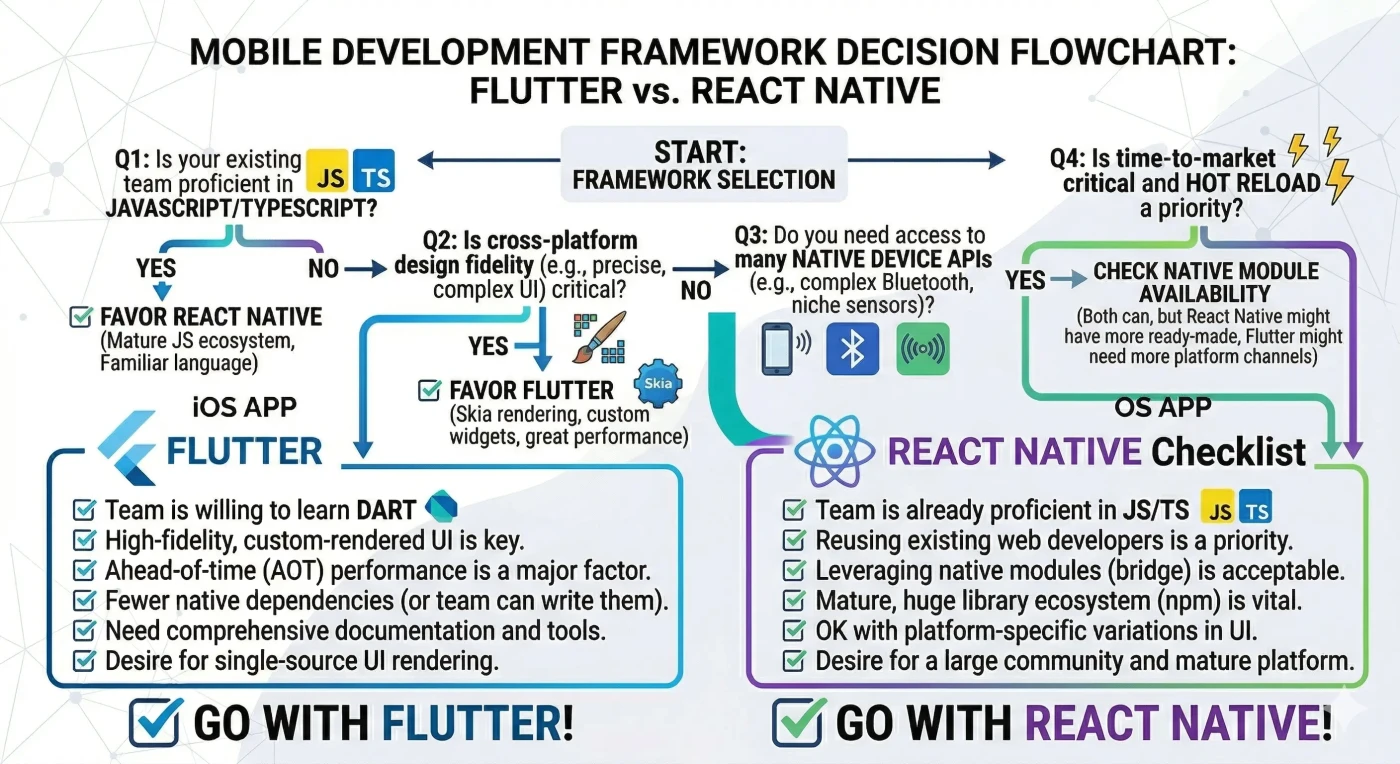
Making Your Decision
After thoroughly researching both frames, how do you decide? Consider these guiding questions.
Choose React Native if…
Your team already has JavaScript and React expertise. Leveraging existing expertise accelerates growth and reduces risk. Familiarity enables faster productivity and fewer learning curve surprises.
Developer availability is a primary concern. If you're hiring developers or choosing agencies, React Native's larger talent pool offers more options. It is easier to find skilled React Native developers than it is to find Flutter developers in most markets.
You do a large-scale integration with existing JavaScript/React web applications. Sharing code between React web apps and React Native mobile apps can significantly speed up development and reduce the maintenance burden.
Your app should feel as natural as possible on each platform. React Native's use of true native components ensures cross-platform behavior with no extra effort.
Your app needs a package that exists for React Native, but not for Flutter. While both ecosystems are widespread, React Native's long history means that some specific integrations only exist there.
Choose Flutter If...
You start with a new team or you have flexibility in your choice of technology. Without any existing JavaScript investment, Flutter's consistent development experience and robust tools provide advantages.
Pixel-perfect design consistency is essential across all platforms. If your brand needs a unified look across iOS and Android, Flutter's rendering control naturally achieves this.
Performance is critical for animations or complex graphics. Flutter's direct rendering architecture provides modest performance gains for visually intensive applications.
You will target mobile as well as web and desktop. Flutter's unified cross-platform approach offers a more coherent path forward than React Native's fragmented multi-platform history.
You prefer a more "batteries included" framework with official solutions for common needs. Flutter's extensive standard library and official packages reduce third-party dependency decisions.
When Either Works Well
For standard business applications - e-commerce, social features, content delivery, productivity tools, booking systems and similar use cases - both frameworks deliver excellent results. Your choice may appropriately depend on team priority, available talent, or even which framework's documentation and community you find more useful.
Don't worry about this decision. Both are capable, mature frameworks backed by resourceful companies. Both produce apps that are used by millions of people. A skilled team can succeed with all options.
The Future Outlook
Both frameworks continue to evolve. Understanding their trajectories helps assess long-term feasibility.
React Native's Direction
Meta continues to invest heavily in React Native and uses it for significant parts of Facebook, Instagram and other applications. New architectures (Fabric, TurboModule, JSI) address historical performance limitations and are now widely adopted.
The React Native community is still vibrant, with active development of the core framework and ecosystem packages. Microsoft's commitment – they actively use and contribute to React Native for critical applications – adds enterprise support beyond Meta alone.
With continuous improvements in performance, developer experience, and platform features, the future of React Native looks stable and positive.
Flutter's Trajectory
Google's commitment to Flutter has grown stronger over time. Internal use of Google Pay and other critical applications reflects organizational investment. Flutter's expansion across web and desktop platforms signals an ambitious long-term vision.
Flutter's growth rate is higher than React Native, closing the adoption gap. Developer surveys consistently show high satisfaction among Flutter developers, often exceeding React Native satisfaction levels.
With rapid capacity expansion and increasing ecosystem maturity, the future of Flutter looks exceptionally bright.
The Honest Assessment
Both frameworks will continue to exist and thrive for the foreseeable future. None of these are likely to be abandoned or obsolete. Choosing one for the 2026 project means choosing a technology with strong long-term support capabilities.
Technology choices should focus on current capabilities and fit rather than speculation about future dominance. By the time one framework clearly "wins" (if it does), your app will have been rebuilt anyway.
Conclusion: A practical perspective
Flutter and React Native both represent excellent choices for cross-platform mobile development in 2026. Passionate debate about which is "better" often obscures the practical truth: for most projects, both frameworks will serve you well.
React Native offers the benefits of JavaScript familiarity, a large developer pool, and a mature ecosystem. Flutter offers an exceptional development experience, pixel-perfect design controls, and consistent cross-platform features.
Your decision should depend on practical factors: your team's existing expertise, the recruiting market, your specific design needs, and cross-platform ambitions. These concrete considerations matter more than benchmark comparisons or theoretical architectural advantages.
What matters most is execution. A well-built React Native app will perform better than a poorly-built Flutter app, and vice versa. The framework provides tools; Your team provides the craftsmanship. Choose competent partners, invest in quality, and any structure will meet your business goals.
The best framework is one that your team can execute with excellence. Choose the right option based on your situation, then focus your energy on creating something valuable instead of second-rate technology decisions.
Ready to Start Your Cross-Platform App Project?
At ConsoleOps, we have expertise in both Flutter and React Native. We'll help you evaluate which framework best fits your specific needs then execute your vision with the craftsmanship that makes the framework choice secondary to the quality of the result.
Discuss Your App Project with ConsoleOps →
Let's determine the right approach for your goals and build something exceptional.
Frequently Asked Questions
Is Flutter better than React Native in 2026?
None of these are objectively better - they excel in different situations. Flutter offers better design consistency, slightly better performance, and consistent cross-platform support. React Native offers a larger developer pool, JavaScript expertise, and a more mature ecosystem. The "better" option depends on the team's expertise, design needs, and specific project requirements.
Which is easier to learn, Flutter or React Native?
For developers with JavaScript and React experience, React Native is easy – existing knowledge is transferred directly. For beginners or developers coming from scripted languages like Java or C#, Flutter's learning curve is similar or possibly smoother due to its extensive documentation and consistent tools. Most developers become productive with any framework within four to eight weeks.
Is Flutter faster than React Native?
Flutter has a slight performance advantage in benchmarks due to direct native code compilation compared to React Native's bridge architecture. However, for typical business applications, this difference is not noticeable to the user. Both frameworks produce apps that feel responsive and intuitive. Performance should only be a deciding factor for apps with extreme graphics or animation requirements.
Which companies use Flutter vs React Native?
React Native powers apps for Meta (Facebook, Instagram), Microsoft, Shopify, Discord, Pinterest, Walmart, and Bloomberg. Flutter powers apps for Google (Google Pay), BMW, eBay Motors, Alibaba, Toyota, and Philips. Both frameworks have proven themselves in demanding, high-scale applications serving millions of users.
Can I use Flutter or React Native for web development?
Both support web development, but with different levels of maturity. Flutter's web support is more integrated and mature, allowing a truly unified codebase across mobile and web. React Native Web exists, but is less seamlessly integrated - many teams use React Native for mobile as well as standard React for web. Flutter today offers a more holistic solution for integrated mobile/web development.
How do Flutter and React Native costs compare?
The total project cost is the same, but with a different structure. React Native developers are a bit more accessible and can cost 10-20% less per hour. However, Flutter's development efficiency sometimes compensates, resulting in reduced total hours. For most projects, cost differences between frameworks are less significant than cost differences between development teams of different quality and experience.