E-commerce Trends: Beyond the Template - Building Custom High-Performance Shopping Experiences
TL;DR (Quick Summary)
- Custom-built e-commerce sites outperform templates in speed, conversions, and UX.
- Headless and composable
commerce lets brands scale with flexibility.
- AI personalization and
real-time analytics drive better product discovery.
- Core Web Vitals and UX optimization are now ranking and conversion essentials.
- In 2026, “custom” isn’t luxury - it’s the foundation for growth.
Why the Best E-commerce Brands Are Breaking the Mold
Most e-commerce websites today look nearly the same. You can almost guess the theme - the layout, the buttons, even the “Add to Cart” animation.
But the brands that are winning? They’re rewriting the rules. They’re ditching cookie-cutter Shopify themes and investing in custom experiences that make customers feel something - not just scroll and click.
Brands that evolve beyond template
thinking see faster page speeds, 40–60% higher engagement, and stronger brand
loyalty. Let’s explore why “custom” is the future of high-performance commerce.
What Does “Beyond the Template” Really Mean in 2026?
In the simplest terms, it means moving from pre-set limitations to total creative freedom.
Traditional e-commerce templates were built for speed and simplicity, but they limit performance and originality. Modern e-commerce platforms like Shopify Plus, Magento, and headless frameworks such as Next.js or Nuxt have changed the game.
|
Old Template
Approach |
Modern Custom
Approach |
|
Rigid layout and theme dependencies |
Flexible, modular UI components |
|
Shared code (slow performance) |
Custom-tailored code (optimized speed) |
|
Limited SEO control |
Full schema + structured data setup |
|
Generic user journey |
Personalized, AI-driven interactions |
Example:
A skincare brand replaced a template-based Shopify store with a custom headless
setup using Shopify Plus + Next.js. The result?
- 38% faster load times
- 22% higher add-to-cart rate
- 15% higher repeat purchase rate
Customization doesn’t just look better - it performs better.
Headless Commerce: The Engine Behind Custom Performance
Headless commerce separates the
front-end (what users see) from the back-end (where data lives). This gives
developers complete control over design, UX, and integrations - without being
locked into one platform’s limits.
Why it matters:
- Faster performance due to lightweight front-ends.
- Seamless API integrations (ERP, CMS, AI tools).
- Freedom to design unique experiences for mobile, web, and in-store kiosks.
In practice:
A fashion brand moved from WooCommerce to a headless setup using Shopify Plus
and Sanity CMS. Within three months, average time-on-site jumped by 48%, and
bounce rate dropped by 30%.
Composable Commerce - Building a Store That Evolves With
You
Composable commerce means handpicking the best tools for each business function.
Think of it like assembling a dream team
of specialized apps: - Algolia for search
- Klaviyo for retention
- Contentful for content
- Shopify Plus for checkout
- Segment for analytics
Micro-story:
A luxury jewelry brand used composable architecture to connect their 3D product
viewer with live inventory and personalized recommendations. The result felt
fluid, intuitive, and surprisingly human - exactly what modern shoppers expect.
Core Web Vitals and the UX-Conversion Connection
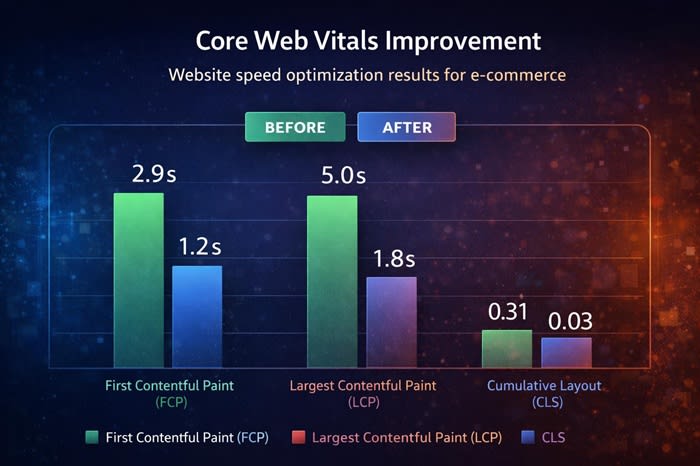
Core Web Vitals aren’t optional - they’re revenue drivers. LCP should be under 2.5s, TBT under 200ms, and CLS
under 0.1.
When a product page loads instantly, navigation feels intuitive, and images pop without lag, users stay longer and buy more.
Personalization AI - From “Recommended for You” to
Predictive Experience
AI personalization has moved far beyond showing users what’s “popular.”
In 2026, the top-performing e-commerce platforms are using behavioral prediction models that anticipate needs - not just react to clicks.
Example:
Imagine an outdoor gear site that recognizes returning users who often browse camping equipment. Instead of recommending random tents, it surfaces products based on:
-
Weather forecasts for their region
Past purchases and returns
-
Local inventory availability
That’s not just smart - it’s human-like service powered by data.
Platforms like Nosto, Bloomreach, and Salesforce Commerce Cloud use this level of insight to lift conversions by 25 - 45%.
AI Tip:
Train personalization engines with first-party data - purchase history, email interactions, and loyalty behavior - not just cookies. It’s privacy-safe and more accurate.
Mobile-First, Not Mobile-Forced
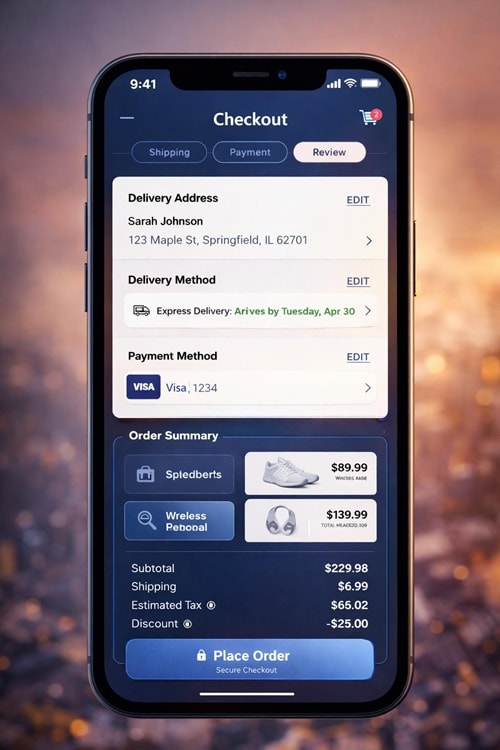
Most “mobile-optimized” stores are
just shrunken desktop layouts. A truly mobile-first design rethinks everything
from thumb zones to checkout flow.
What this means:
- Sticky CTAs near thumb reach
- Biometric login
- Vertical video demos
- Native-feeling AI chat support
A cosmetics retailer rebuilt checkout for
one-screen simplicity and saw a +37% conversion lift. This isn’t design flair - it’s strategic empathy.
Performance Optimization - Every Millisecond Counts
Your e-commerce performance is your first impression. A delay of even 100ms can impact conversions.
Checklist:
-
Compress and convert images to WebP format
Implement lazy loading and prefetching
-
Use CDN caching (Cloudflare, Fastly)
-
Optimize CSS/JS for minimal blocking
-
Add descriptive alt text for images (boosts SEO + accessibility)
In custom e-commerce builds, these optimizations are hardcoded - not added via plugins - resulting in faster real-world performance.
Data-Driven Product Discovery: Helping Shoppers Find What They Don’t Know They Want
Product discovery isn’t about showing all options - it’s about showing the right ones.
Modern e-commerce leaders use:
-
Predictive search (Algolia, Elasticsearch)
-
AI-driven filtering (e.g., “best for oily skin,” “cold-weather gear”)
-
Visual similarity search (upload a photo, find a match)
These tools turn browsing into an intuitive journey.
When customers feel “understood,” they don’t bounce - they buy.
Brand Authenticity as UX: The Invisible Differentiator
A custom-built site lets your brand feel authentic.
Typography, motion, tone - every detail communicates who you are.
Templates make your brand “look like everyone else.”
Custom design makes it memorable.
Pro Insight:
In AI-driven search, brand authority and reputation signals are increasingly part of ranking systems. Custom UX helps users remember you - and talk about you. That’s the ultimate organic signal.
From Template Stores to Tech-Enabled Ecosystems
E-commerce is no longer a website - it’s an ecosystem.
APIs, automation, data pipelines, and personalization engines connect every customer touchpoint.
Your job isn’t to design a page - it’s to design an experience.
When you move beyond templates, you move into control - of your story, your speed, and your success metrics.
Practical Takeaways - How to Go Beyond the Template
|
Priority |
Action |
Tool/Example |
|
Performance |
Audit Core Web Vitals |
PageSpeed Insights, GTmetrix |
|
UX |
Redesign navigation & checkout |
Hotjar, Figma |
|
Personalization |
Integrate AI recommendations |
Nosto, Bloomreach |
|
Architecture |
Explore headless/composable setup |
Shopify Hydrogen, Vue Storefront |
|
Data |
Enable unified analytics |
Segment, GA4 |
|
Schema |
Add Product + FAQ schema |
RankMath or manual JSON-LD |
|
Content |
Refresh product copy |
Human editor + SEO audit |
Start small: customize checkout, then expand to full architecture.
Every improvement compounds.
Final Thought: The Future Belongs to Custom
Templates had their moment. They democratized e-commerce. But now,
they’re holding ambitious brands back.
Performance, personalization, and brand identity are inseparable - and that’s only possible when you build, not borrow, your experience.
FAQs
Q1: Why
are custom e-commerce sites outperforming templates?
They’re faster, more adaptable, and deliver better UX because they’re optimized
for performance and brand identity.
Q2: What’s
the difference between headless and composable commerce?
Headless separates front-end and back-end; composable integrates specialized
tools for each function.
Q3: How do
AI Overviews affect e-commerce SEO?
They reward concise, structured, people-first content with strong E-E-A-T and
schema.
Q4: How
long does a custom e-commerce build take?
Typically 8–16 weeks depending on integrations.
Q5: What’s
the ROI of custom e-commerce development?
Most brands see measurable gains within 3-6 months.